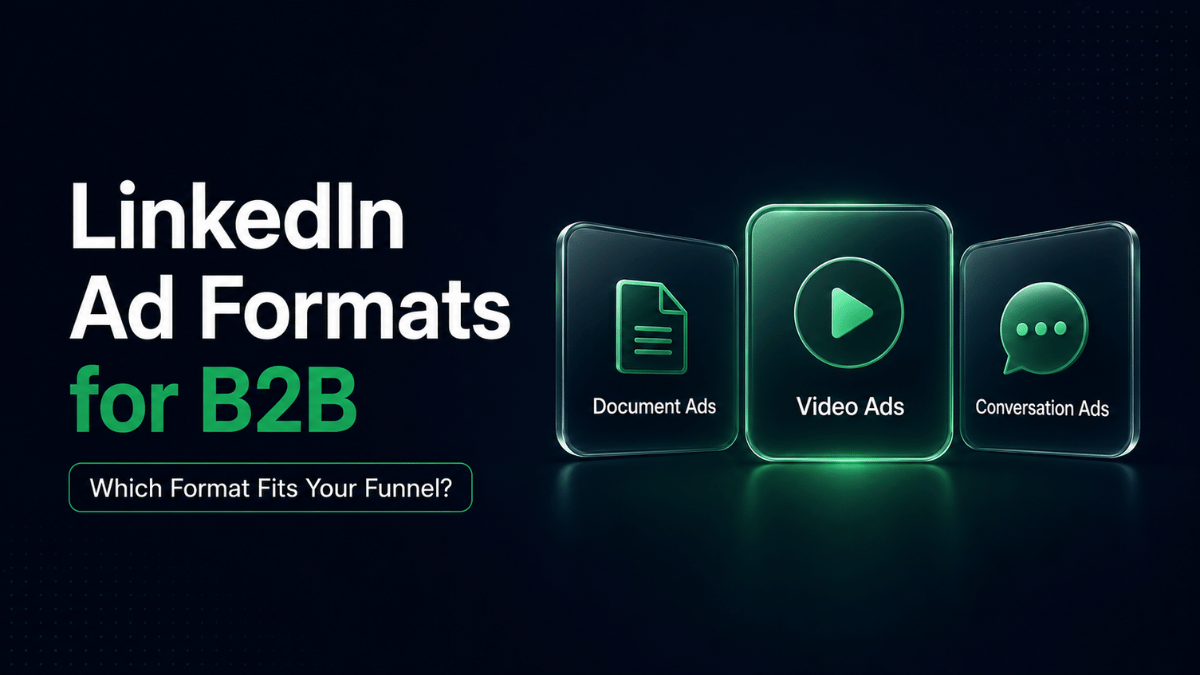
Choosing the right LinkedIn ad format can affect how well your campaign attracts attention, educates prospects, captures leads, or encourages direct action. For B2B businesses, format selection should not be based only on what looks creative or popular. It should depend on the campaign objective, buyer readiness, offer type, and funnel stage.
This guide compares LinkedIn Document Ads, Video Ads, and Conversation Ads so businesses can choose the format that fits their funnel and lead generation goals.
Why LinkedIn Ad Format Choice Matters for B2B Campaigns
LinkedIn Ads can support different parts of the B2B funnel, but not every ad format fits every campaign objective.
For example, a cold audience may need education before they are ready to enquire. In that case, a content-led format may work better than a direct sales message. A warmer audience may respond better to a consultation offer, webinar invite, or guided CTA.
That is why format selection should depend on the audience stage, campaign objective, offer type, and next step.
A stronger LinkedIn campaign should consider:
- whether the audience is cold, warm, or ready to take action
- whether the campaign goal is awareness, lead generation, or nurture
- whether the offer needs explanation before conversion
- whether the format supports the next step after the click
When the format matches the funnel stage, the campaign becomes easier to understand, measure, and optimise.
What Are LinkedIn Document Ads Best Used For?
LinkedIn Document Ads are useful for promoting document-style content such as guides, reports, checklists, whitepapers, case studies, frameworks, or educational resources.
For B2B campaigns, Document Ads are often useful when the audience needs more information before they are ready to enquire. Instead of asking for direct action immediately, the business gives prospects something helpful first.
Document Ads may be suitable for:
- educating cold audiences
- sharing reports, guides, or frameworks
- promoting thought leadership
- capturing leads through value-led content
- supporting longer B2B buying cycles
The strength of Document Ads is that they help turn complex B2B topics into useful content. However, they are usually stronger for education, awareness, and consideration rather than instant conversion.
| Best Use Case | Why It Works |
| Educating cold audiences | Helps prospects understand a problem before they are ready to enquire. |
| Sharing reports or frameworks | Makes complex topics easier to consume. |
| Capturing leads through useful content | Gives prospects a reason to exchange details for valuable information. |
| Supporting longer B2B buying cycles | Helps nurture interest before a direct sales conversation. |
What Are LinkedIn Video Ads Best Used For?
LinkedIn Video Ads are useful when a business needs to explain a message visually. They can help introduce a business problem, explain a service, show proof, or build awareness around a topic.
For B2B campaigns, Video Ads are often useful when the message needs context. They can help the audience understand who the business helps, what problem is being addressed, and why the solution matters.
Video Ads may be suitable for:
- building brand or topic awareness
- explaining a complex service
- introducing a product or platform
- showing proof, results, or case study highlights
- retargeting audiences who already engaged with the brand
The strength of Video Ads is attention and message delivery. A good video can make a complex idea easier to understand, but it still needs a clear hook, message, and next step.
| Best Use Case | Why It Works |
| Building awareness | Helps introduce the business or topic to a wider professional audience. |
| Explaining complex services | Makes abstract or technical ideas easier to understand. |
| Showing proof or credibility | Can highlight results, case studies, or expert perspectives. |
| Retargeting engaged audiences | Reinforces messages to people who have already interacted with the brand. |
What Are LinkedIn Conversation Ads Best Used For?
LinkedIn Conversation Ads are useful when a business wants to guide prospects toward a specific action through a message-style experience.
For B2B campaigns, Conversation Ads usually work better when the audience already has some awareness of the topic, problem, or brand. They can support direct engagement, event registration, consultation offers, demo requests, downloadable resources, or nurture campaigns.
Conversation Ads may be suitable for:
- webinar or event promotion
- consultation offers
- demo requests
- service enquiries
- downloadable resources
- retargeting warm audiences
- guided CTA journeys
The strength of Conversation Ads is guided action. Instead of showing only one CTA, the campaign can offer a simple flow that helps prospects choose the next step that fits their interest.
| Best Use Case | Why It Works |
| Engaging warm prospects | Works better when the audience already has some awareness or relevance. |
| Promoting events or webinars | Gives users a clear CTA path to register or learn more. |
| Offering consultations or demos | Guides qualified prospects toward direct action. |
| Supporting nurture campaigns | Helps continue the journey after earlier campaign engagement. |
However, Conversation Ads may feel too direct if the audience is completely cold or if the offer is unclear. The message should be relevant, concise, and aligned with the audience’s stage.
How These LinkedIn Ad Formats Compare by Funnel Stage
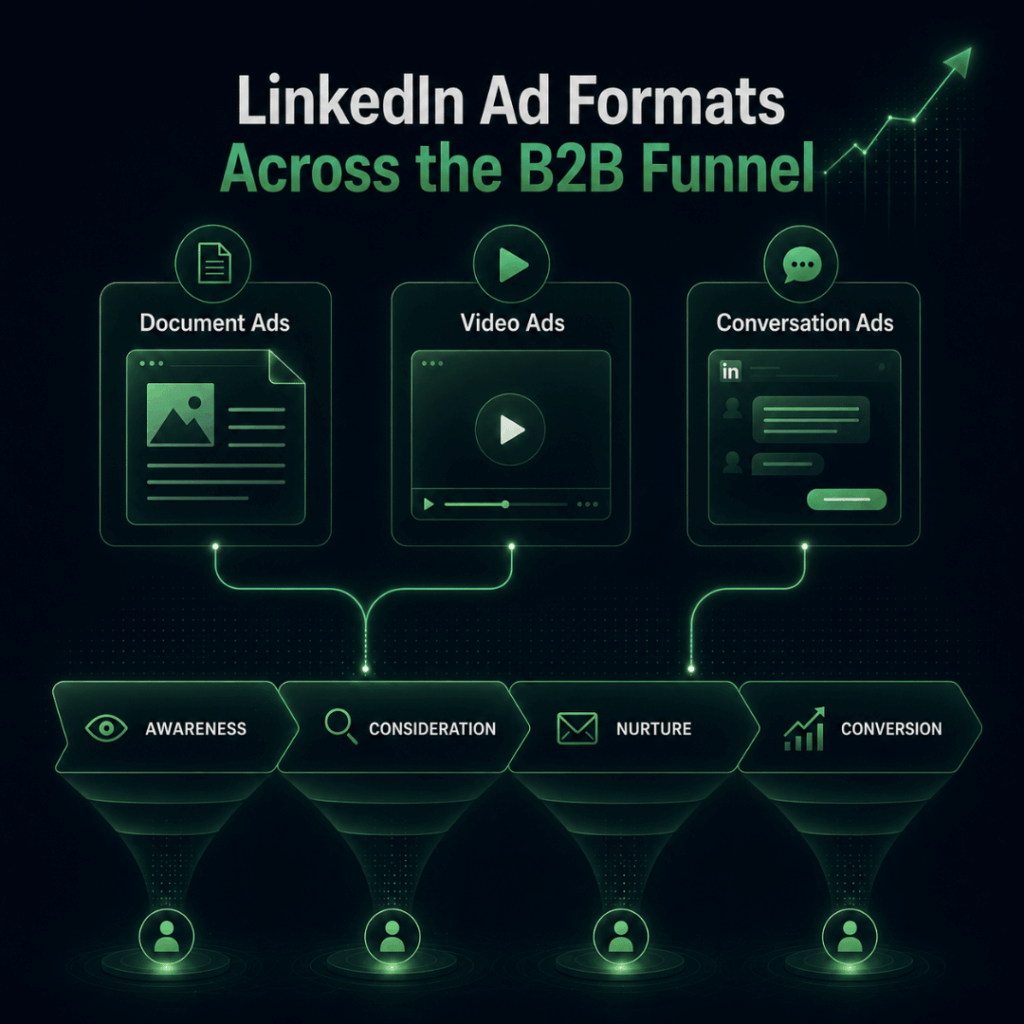
Different LinkedIn ad formats can support different parts of the funnel. The best format depends on whether the business wants to build awareness, educate prospects, capture leads, nurture interest, or encourage direct action.
| LinkedIn Ad Format | Best For | Funnel Stage | Main Strength |
| Document Ads | Guides, reports, checklists, frameworks, thought leadership | Awareness / Consideration | Educates prospects and captures interest through useful content |
| Video Ads | Brand message, positioning, service explanation, proof, storytelling | Awareness / Consideration | Builds attention, understanding, and recall |
| Conversation Ads | Consultation offers, events, demos, guided CTAs, retargeting | Consideration / Conversion | Encourages direct engagement and guided action |
This comparison shows why format selection should not be random. Each format has a different role.
Document Ads can help prospects learn.
Video Ads can help prospects understand.
Conversation Ads can help prospects take action.
For B2B campaigns, the best approach is often not to use only one format. A business may use different formats at different funnel stages.
| Funnel Stage | Possible Format | Example Campaign Use |
| Awareness | Video Ads | Introduce a business problem or explain why the topic matters |
| Awareness / Consideration | Document Ads | Promote a guide, report, checklist, or framework |
| Consideration | Video Ads or Document Ads | Share proof, case studies, or educational content |
| Nurture | Conversation Ads | Guide engaged prospects to a webinar, consultation, or resource |
| Conversion | Conversation Ads | Encourage direct enquiries, demo bookings, or event registration |
Which LinkedIn Ad Format Fits Awareness, Lead Generation, and Nurture Goals?
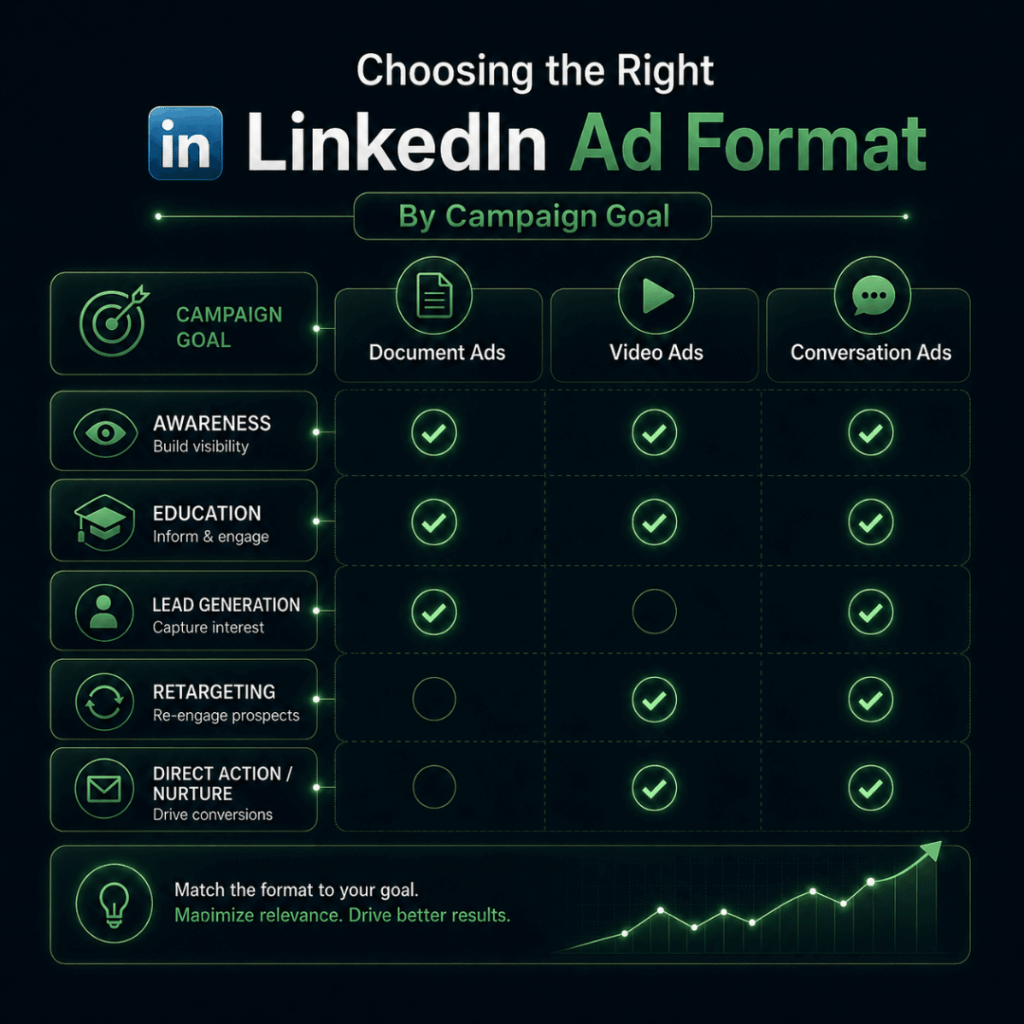
The right LinkedIn ad format depends on what the campaign needs to achieve.
If the goal is awareness, Video Ads may be useful because they can introduce the message quickly and create recall. Document Ads can also support awareness when the content is educational and useful for early-stage buyers.
If the goal is lead generation, Document Ads may work well when the business has a valuable guide, report, checklist, or resource to offer. Conversation Ads may also support lead generation when the audience is more ready for direct engagement.
If the goal is nurture, Conversation Ads can help guide warm audiences toward the next action. Video Ads can also support nurture by reinforcing the message or showing proof.
| Campaign Goal | Suggested Format |
| Educate cold B2B audiences | Document Ads |
| Explain a complex service | Video Ads |
| Build brand or topic awareness | Video Ads |
| Promote a guide, report, or checklist | Document Ads |
| Promote a webinar or consultation | Conversation Ads |
| Retarget engaged prospects | Video Ads or Conversation Ads |
| Capture leads from a value-led asset | Document Ads |
| Encourage direct action from warm audiences | Conversation Ads |
The key is to match the format with the buyer’s readiness.
A cold audience may need content and education first. A warm audience may respond better to proof, retargeting, or a clearer CTA. A ready audience may be more suitable for direct conversation, consultation, or demo offers.
Explore our LinkedIn Advertising Service in Malaysia to understand how we help B2B businesses choose the right LinkedIn ad format based on funnel stage, campaign objective, and lead generation goals.
Common Mistakes Businesses Make When Choosing LinkedIn Ad Formats
Choosing the wrong format can reduce campaign effectiveness even when the audience targeting is strong.
Common mistakes include:
- using the same ad format for every campaign objective
- expecting direct enquiries from cold audiences too early
- using Video Ads without a clear message or hook
- using Conversation Ads before the audience is warm enough
- choosing formats without reviewing the landing page, lead form, or follow-up process
For B2B campaigns, the format should match the buyer’s readiness. If the campaign format does not fit the funnel stage, even good targeting may underperform.
How to Choose the Right LinkedIn Ad Format for Your Campaign
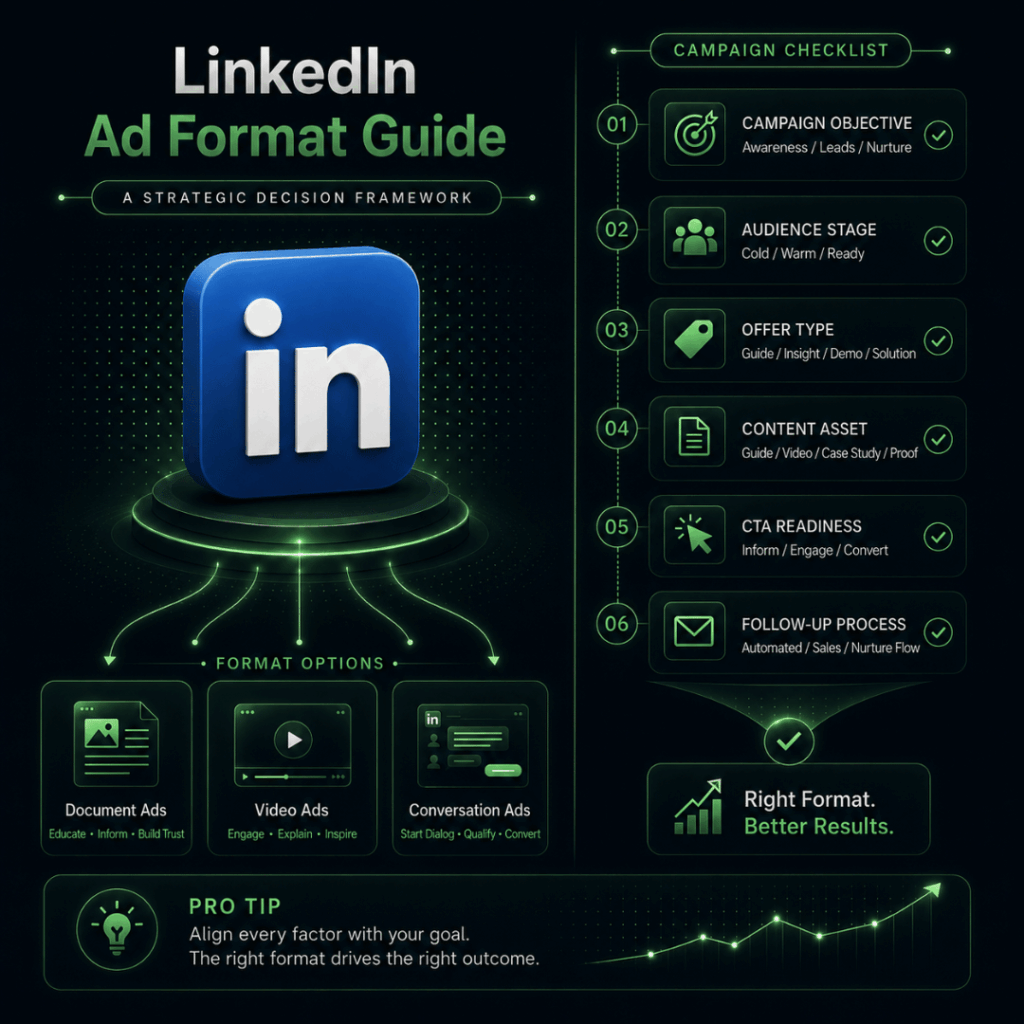
To choose the right LinkedIn ad format, start with the campaign objective, audience stage, and offer type.
| Question to Ask | What It Helps You Decide |
| Are we trying to build awareness or generate direct leads? | Whether to prioritise Video Ads, Document Ads, or Conversation Ads |
| Is the audience cold, warm, or already familiar with our brand? | How direct the message and CTA should be |
| Does the offer need explanation before someone takes action? | Whether Video Ads or Document Ads should come before a direct CTA |
| Do we have a useful guide, report, checklist, or document asset? | Whether Document Ads are suitable |
| Would video help explain the message more clearly? | Whether Video Ads can support awareness or consideration |
| Is the audience ready for a direct CTA or guided flow? | Whether Conversation Ads are suitable |
| What happens after the user clicks, watches, downloads, or responds? | Whether the landing page, lead form, and follow-up process are ready |
If your campaign needs to educate, Document Ads may be suitable. If your campaign needs to explain or build recall, Video Ads may be suitable. If your campaign needs guided engagement from a warmer audience, Conversation Ads may be suitable.
The strongest format is the one that matches the campaign goal, not necessarily the one that looks the most creative.
Ready to Build a Better LinkedIn Campaign Funnel?
LinkedIn ad formats should support the buyer journey, not work separately from it.
Document Ads, Video Ads, and Conversation Ads can all be useful, but they play different roles. Document Ads can educate and capture interest. Video Ads can build awareness and explain messages. Conversation Ads can guide warmer prospects toward action.
Before choosing a format, businesses should review the audience stage, campaign objective, offer type, and lead generation goal.
For B2B campaigns, the right ad format often matters as much as the audience setup. If the campaign format does not match buyer readiness, even strong targeting may underperform.
Speak to our team about the right LinkedIn ad format for your funnel and how to build a stronger B2B campaign structure.