Component 01 · Strategy
brand strategy consultant
Brand OS &
Market Positioning
KE builds Brand Operating Systems for growing companies that need clearer positioning, consistent messaging, digital design alignment, sales-ready touchpoints, and go-to-market readiness — so the brand can scale beyond one founder, one designer, or one website project.
A brand guideline tells people how your brand should look. A Brand OS helps your company look consistent, write faster, sell better, rank better, and launch with alignment.
MOF #357-0002356673
Founded 2013
200+ projects delivered
Brand OS Architecture
01
Foundation
Positioning
Who you serve · how you win · why you win
02
Identity
Brand Guideline System
Logo · colour · typography · visual governance
03
Voice
Messaging & Content System
Copy rules · headline formulas · proof bank
04
Digital Design
Digital Design System
UI tokens · web components · responsive patterns
05
Execution
Brand Touchpoint Templates
Proposals · decks · email · documents · social
06
Growth
Website & GTM Alignment
Service pages · launch readiness · sales flow
Consistent brand execution — independent of any single person
The Brand Consistency Problem
Brand inconsistency
becomes a growth problem.
Most growing businesses have a brand — a logo, a website, some social posts. Very few have a brand system. Without a system, every new hire, vendor, campaign, and sales pitch produces a slightly different version of the brand. Over time, the inconsistency compounds into a problem that slows sales, complicates hiring, and makes expansion harder.
Brand failure 01
“Nobody can explain what we do.”
The company cannot clearly explain who it serves, why it is different, and why customers should choose it over alternatives. Every founder, salesperson, and marketer gives a slightly different answer — because there is no documented positioning system.
Root cause: positioning never documented as a reusable system
Brand failure 02
“Everything looks different.”
The website, sales deck, proposal, social posts, and marketing materials look like they came from different companies. Different vendors, different designers, and different team members each interpret the brand differently — because there is no digital design system or governance layer.
Root cause: no design system or visual governance across touchpoints
Brand failure 03
“We rewrite everything from scratch.”
Every proposal, campaign brief, service page update, and sales message starts from zero. There are no reusable copy frameworks, no approved proof claims, no headline formulas, and no content governance — so every piece of communication is a one-off effort.
Root cause: no messaging system, copy rules, or content governance
Brand OS turns brand decisions into reusable systems, templates, messaging rules, digital design standards, and GTM-ready touchpoints. Not a decorative PDF — a working operational system the whole team can use.
When You Need This
Six signals your
company needs a
Brand OS Build.
Brand OS is not only for companies launching from scratch. It is most valuable — and most urgently needed — when a growing business hits the wall where founder-dependency and brand inconsistency start costing real opportunities.
01
Your company is growing, but brand execution still depends on the founder’s personal explanation
When every new hire, vendor brief, or sales conversation requires the founder to personally explain the brand, the business cannot scale. A Brand OS transfers that knowledge into a documented system the whole team can use.
Founder dependency · Scaling
02
Your website, proposals, decks, and social content feel visually and tonally inconsistent
If a corporate client or investor looked at every surface of your business simultaneously — website, deck, proposal, social, email signature — would they see one coherent brand? If not, the absence of a design system and messaging framework is the cause.
Visual consistency · Credibility
03
Your team keeps asking how to write, design, present, or publish brand materials
Repeated questions about brand are a symptom of missing governance. When every design decision, copy request, and presentation template requires founder approval, a documented Brand OS with clear usage rules eliminates the bottleneck.
Team independence · Governance
04
You are preparing for a website revamp, GTM launch, fundraising round, or regional expansion
Brand OS is especially useful before a major execution moment. Building the operating system before the website, before the launch, or before the expansion ensures every subsequent execution is aligned — rather than needing to retrofit the brand after money is spent.
Website · GTM · Expansion
05
Your brand guideline exists, but nobody uses it in real day-to-day work
A PDF with logo usage rules and colour codes is not a system — it is documentation. When a brand guideline sits unused, it is because it was never connected to the templates, copy frameworks, and design components the team actually needs for daily execution.
Guideline vs system · Adoption
06
You want a practical brand system, not another decorative PDF
KE’s Brand OS Build produces working assets — a positioning framework, a design system, copy rules, templates, and GTM-ready touchpoints — not a 40-page document that gets filed and forgotten. The test: does it make brand execution faster? If not, it is not a system.
Practical execution · Not a PDF
What Brand OS Includes
Six components.
One operating system.
Brand OS is not a single deliverable — it is a layered system. Each component builds on the one before it, from the market positioning foundation through to the execution-ready touchpoints and digital alignment that connect brand to growth.
Layer 01 · Foundation
Market Positioning System
Who the company serves, how it competes, what makes it different, and why customers should choose it. ICP definition, category framing, value proposition, differentiation language, and proof direction — documented as a reusable positioning framework.
Included in all engagement tiers
Layer 02 · Identity
Brand Guideline System
Logo system, colour palette, typography hierarchy, usage rules, image and photography direction, and brand governance documentation — so every vendor, designer, and team member works from the same visual foundation.
Can be scoped as a module
Layer 03 · Digital Design
Digital Design System
Website UI tokens, component library, button and card styles, spacing system, and responsive design patterns — ensuring digital consistency across every web surface, product interface, and landing page without starting from scratch each time.
Can be scoped as a module
Layer 04 · Voice
Messaging & Content System
Brand voice, headline formulas, service copy rules, proof and claims bank, SEO/AEO/GEO copy direction, and content governance — so every piece of communication sounds consistent whether written by the founder, a new hire, or an external copywriter.
Can be scoped as a module
Layer 05 · Execution
Brand Touchpoint Templates
Email signature, proposal cover, document header and footer, deck master template, social media post templates, and sales materials — production-ready, brand-consistent assets the team can use immediately without redesigning from scratch.
Can be scoped as a module
Layer 06 · Growth
Website & GTM Alignment
How the Brand OS connects to website service architecture, landing page direction, campaign message alignment, and sales flow — ensuring that the brand built in the OS is the brand that appears in every growth execution touchpoint. Brand OS is especially useful before a website revamp, GTM launch, new sales push, or regional expansion.
Output: audit summary + gap list
The Architecture
The KE Brand OS
Architecture.
Brand OS is a layered system — not a flat set of deliverables. Each layer builds on the one beneath it. Positioning informs identity. Identity governs voice. Voice governs design. Design and voice govern touchpoints. Touchpoints and design connect to the website and GTM layer. The system makes brand execution consistent across every surface — independent of which person, vendor, or tool produces it.
01
Foundation
Positioning
Who you serve, how you compete, and why you win — the strategic base the entire Brand OS is built on.
ICP definition
Category framing
Value proposition
Differentiation language
02
Identity
Brand Guideline System
Visual identity rules and governance — how the brand looks across every surface.
Logo system
Colour palette
Typography
Image direction
03
Voice
Messaging & Content System
How the brand speaks — copy rules, headline formulas, proof governance, and SEO/AEO/GEO direction.
Brand voice
Headline formulas
Proof bank
Copy governance
04
Digital Design
Digital Design System
Website and product UI consistency — tokens, components, and responsive patterns that make every digital surface coherent.
UI tokens
Component library
Spacing system
Responsive patterns
05
Execution
Brand Touchpoint Templates
Production-ready brand assets for the whole team — from proposals and decks to email signatures and social templates.
Proposal cover
Deck master
Email signature
Social templates
06
Growth
Website & GTM Alignment
Brand OS connected to website service architecture, campaign message direction, and sales flow — so brand and growth execution are aligned from the start.
Service page direction
GTM message alignment
Sales flow
Consistent brand execution across every touchpoint
The full Brand OS model can expand further. Internal brand governance (how the team represents the brand), team onboarding documentation, and growth/GTM systems can be added as the business scales — making the Brand OS a living system that grows with the company rather than a static deliverable.
Build Process
Four phases.
One complete system.
Brand OS Build is not a one-day workshop or a design handoff. It is a structured four-phase process — from diagnostic through to governance — that produces a practical, documented system the whole team can use from day one.
01
Brand & Market Diagnostic
Understand the business model, target audience, current brand assets, website, sales materials, and growth goals. Audit what exists, identify what is missing, and map the gaps before any system is designed.
Output: audit summary + gap map
02
Positioning & System Architecture
Define the market positioning, message hierarchy, design direction, and system layers. Confirm which Brand OS modules are in scope, prioritise the build sequence, and agree on governance rules before production begins.
Output: positioning brief + system scope
03
OS Build
Produce the selected Brand OS modules — brand guideline, digital design system, messaging framework, touchpoint templates, and website/GTM alignment assets. Each module is reviewed and iterated before delivery.
Output: complete Brand OS modules
04
Handoff & Governance
Train the team on how to use the Brand OS, document usage rules and approval flows, set version control standards, and define how future brand materials should be created — so the system remains consistent as the team and business grow.
Output: governance doc + team handoff session
What You Receive
A working system.
Not a PDF filed away.
Brand OS Build produces assets the team can use immediately — not documentation the founder needs to translate into practice. Every deliverable is practical, structured, and connected to the way the business actually operates.
Brand OS strategy summary
Market positioning statement and ICP direction
Differentiation framework and proof direction
Brand guideline system — logo, colour, typography, governance
Digital design system direction — UI tokens, components, web standards
Messaging framework — voice, headline formulas, copy rules
Brand touchpoint templates — proposal, deck, email, documents, social
Website and GTM alignment notes — service architecture, launch direction
Governance and versioning rules — how future materials should be created
Team handoff session — usage, approval flows, practical onboarding
Brand OS is a practical operating system, not decorative documentation. Every deliverable is designed to be used in real work — by the team, by vendors, by new hires, and by the tools and systems that produce brand touchpoints. The test: does it make brand execution faster and more consistent? If not, it is not a Brand OS.
Practical · not decorative
Team-ready
Vendor-usable
GTM-ready
Governed
This is a Brand OS strategy and system build. Logo redesign, full website development, campaign execution, video production, and ongoing content production are separate scopes unless included in the proposal.
Engagement Tiers
Which Brand OS
scope fits you?
Every engagement starts with positioning and builds up through the layers most relevant to your current stage and priorities. Modules can be scoped independently or bundled into a full Brand OS Build.
| Module / Output | Brand OS Foundation Sprint Positioning + core system | Brand OS Build Full system | Full Brand OS + Website / GTM Alignment OS + execution layer |
|---|---|---|---|
Market positioning |
Included |
Included |
Included |
Brand guideline system |
Directional |
Included |
Included |
Messaging system |
Core framework |
Full framework |
Full framework |
Digital design system |
Basic direction |
Included | Expanded for website |
Touchpoint templates |
Selected templates | Core templates | Extended templates |
Website / GTM alignment |
Basic notes | Direction notes |
Detailed alignment |
Governance & handoff |
Summary |
Included |
Included |
This is a Brand OS strategy and system build. Logo redesign, full website development, campaign execution, video production, and ongoing content production are separate scopes unless included in the proposal.
Investment Guide
Priced by system depth,
not by deliverable count.
The investment reflects the depth of positioning work, the number of Brand OS layers in scope, and the execution readiness of the outputs — not how many documents are produced.
Positioning + core system
Brand OS Foundation Sprint
Focused positioning and core Brand OS layer. Market positioning, brand guideline direction, core messaging framework, and selected touchpoint templates.
From
12,000
Positioning
Brand direction
Core messaging
Full system
Complete Brand OS
Brand OS Build
Full Brand OS across all six layers — positioning, brand guideline, digital design system, messaging framework, touchpoint templates, and GTM direction notes.
From
28,000
All six layers
Full governance
Team handoff
OS + website / GTM execution layer
Full Brand OS + Website / GTM Alignment
Complete Brand OS Build plus detailed website service architecture, campaign message alignment, and sales flow direction — fully connected to growth execution.
From
58,000
Full OS
Website alignment
GTM-ready
Multi-brand · Corporate · Government
Corporate / Government / Multi-brand OS
Purpose-designed Brand OS engagements for organisations with multiple brands, departments, programme identities, or regional execution requirements.
Scoped after discovery
Custom proposal
Multi-brand
Regional
Governance layer
Brand OS often precedes or connects directly to other KE engagements. After the Brand OS is in place, the natural next steps are a Go-To-Market Strategy, a website build or revamp, a Growth Scope Diagnostic, or direct execution of campaigns, dashboards, or marketing automation — all of which benefit from having a documented brand system to work from.
Why a Brand OS is worth building before the next campaign or website
A company that builds a website without a brand OS produces a website that looks different from its proposals, social posts, and sales decks. A company that runs campaigns without a messaging system produces ads that sound different from its service pages. The cost of brand inconsistency compounds over time — every designer, copywriter, and agency hired without a Brand OS produces a slightly different version of the brand. At RM12,000–RM58,000, a Brand OS Build is a fraction of the cumulative spend on inconsistent brand execution that most growing companies absorb without realising it.
In Practice
What Offer & Funnel Architecture looks like for real businesses.
The architecture changes per business type — but the principle is consistent: design the offer and conversion path before driving traffic into it.
Scenario 01 · Scaling SME
Founder-led brand that needs to scale beyond one person
The brand has always depended on the founder to explain it, approve it, and produce it. Every new hire, vendor, or marketing initiative requires the founder’s direct involvement. The team cannot act independently on brand decisions.
Brand OS Build includes
Positioning documentation, brand guideline with usage rules, messaging framework and copy templates, and a governance system that defines approval flows — so any team member can execute brand work to standard.
What becomes easier
Hiring new marketing staff, briefing freelancers and agencies, producing sales materials, onboarding partners — all without the founder’s direct involvement in every brand decision.
Scenario 02 · Website revamp / GTM launch
Preparing for a website rebuild, product launch, or market expansion
The website needs a revamp, a new product is about to launch, or the company is entering a new market. Without a Brand OS, the new website will look different from the sales deck, the messaging will be inconsistent with the proposals, and the launch will produce a patchwork of brand outputs.
Brand OS Build includes
Positioning and messaging framework for the new launch, digital design system that governs the website and launch materials, and website/GTM alignment notes that connect the Brand OS directly to the revamp or launch execution.
What becomes easier
Website briefs, campaign message direction, vendor onboarding, launch deck production — all working from the same system rather than producing a new brand interpretation for every output.
Scenario 03 · Corporate / programme team
Multiple departments or teams need consistent materials and governance
Different departments, regions, or programme teams produce their own versions of brand materials — each slightly different. Vendor-produced materials conflict with in-house materials. There is no shared standard, no template library, and no approval governance that spans the organisation.
Brand OS Build includes
Brand guideline system with clear usage rules for every department, touchpoint template library covering proposals, decks, documents, and social, and governance documentation defining how future materials are created, approved, and versioned.
What becomes easier
Vendor briefing, department onboarding, material production across teams, approval cycles — all reduced because the system provides the answer before the question needs to be escalated.
Common Questions
Frequently asked questions
Still have questions?
The fastest way to get a direct answer is a Fit Discovery Call — free, 30 minutes, no pitch.
Build Your Brand OS →MOF #357-0002356673 · Elite Growth Tech Sdn Bhd
Component 01 · Strategy · KE Growth Engine™
Ready to build the
operating system
behind brand consistency?
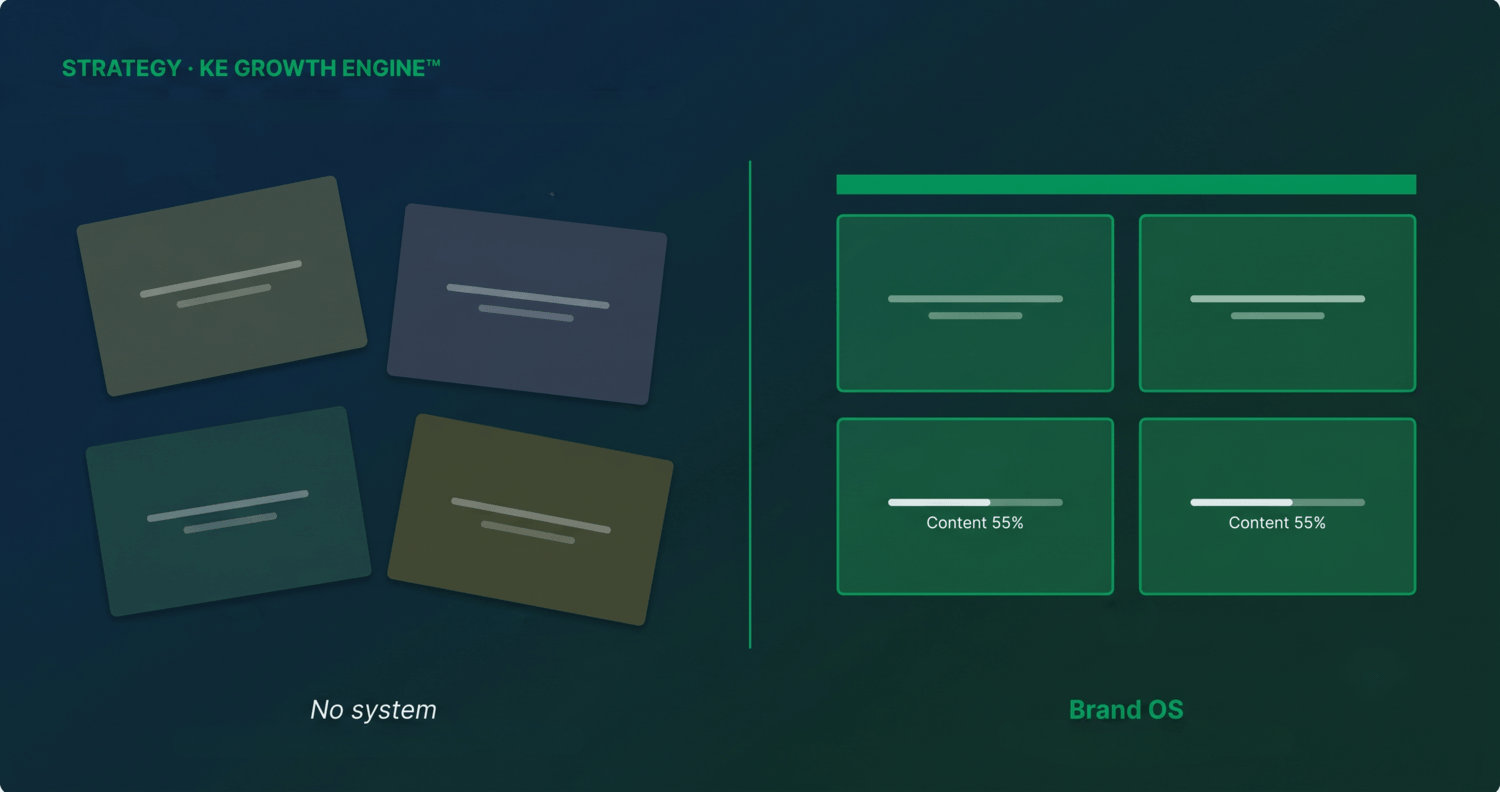
Before the next campaign, website launch, GTM push, or regional expansion — build the brand OS first so every execution is working from the same system.
Also see:
Go-To-Market StrategyGrowth Scope DiagnosticWebsite BuildAEO/GEO VisibilityMarTech AdvisoryMOF #357-0002356673
200+ projects delivered
Founded 2013
If we’re not the right fit, we’ll let you know honestly.