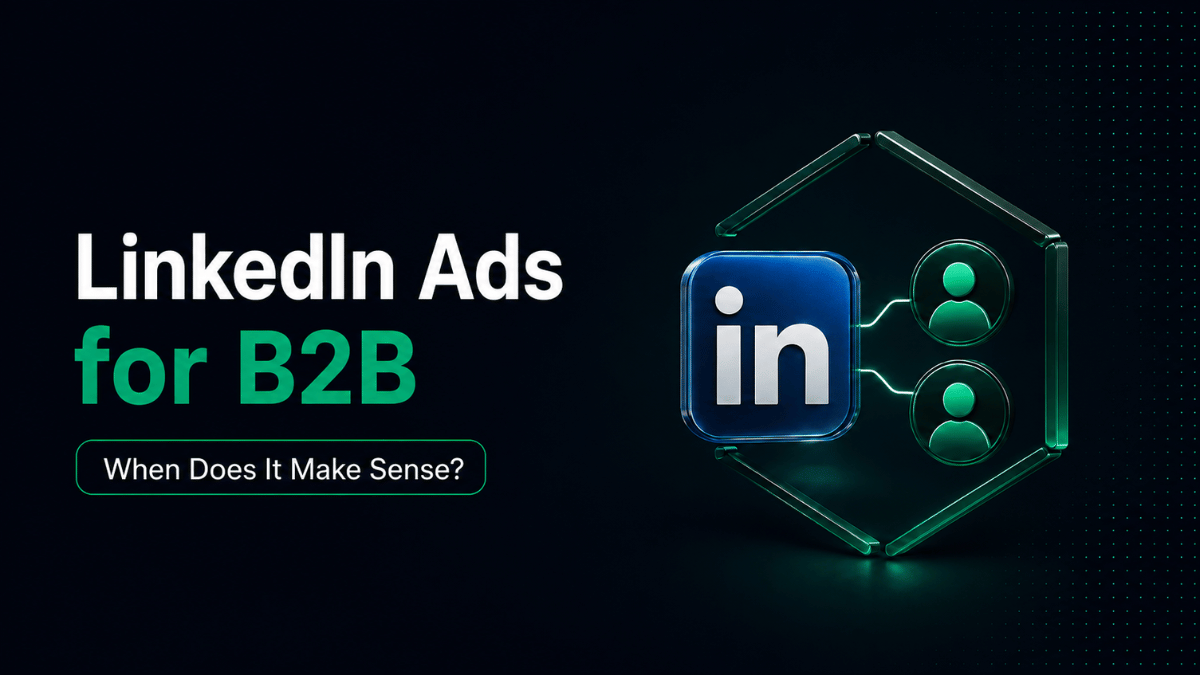
LinkedIn Ads can be a strong channel for B2B lead generation, especially when a business needs to reach specific decision-makers, professional audiences, or higher-value prospects. However, it is not always the right channel for every company.
Before investing more budget, businesses should understand the real pros and cons of LinkedIn Ads. The platform can support precise audience targeting and better lead quality, but it also requires a clear offer, proper funnel readiness, realistic budget expectations, and a strong follow-up process. Understanding the pros and cons of LinkedIn Ads helps B2B businesses decide whether the channel fits their audience, funnel, budget, and lead generation goals.
This guide explains when LinkedIn Ads makes sense for B2B businesses, when it may not be the best fit yet, and what businesses should prepare before using it as part of their lead generation strategy.
Why B2B Businesses Consider LinkedIn Ads Services
Many B2B businesses consider LinkedIn Ads services because the platform provides access to professional audiences in a business-focused environment.
For companies selling services, software, consulting, training, recruitment, finance, industrial solutions, or other B2B offers, reaching the right audience is often more important than reaching the largest audience.
LinkedIn Ads can help businesses reach people based on professional signals such as job role, seniority, company type, industry, location, and business interest. This makes it useful for campaigns that need to connect with decision-makers, managers, founders, directors, department heads, or niche business audiences.
However, LinkedIn Ads should not be treated like a simple traffic channel. B2B buyers usually take longer to make decisions. They may need to compare options, discuss internally, review the offer, and understand the business value before enquiring.
That is why LinkedIn Ads works best when it is connected to a clear lead generation strategy, not just a campaign launch.
Pros and Cons of LinkedIn Ads for B2B Lead Generation
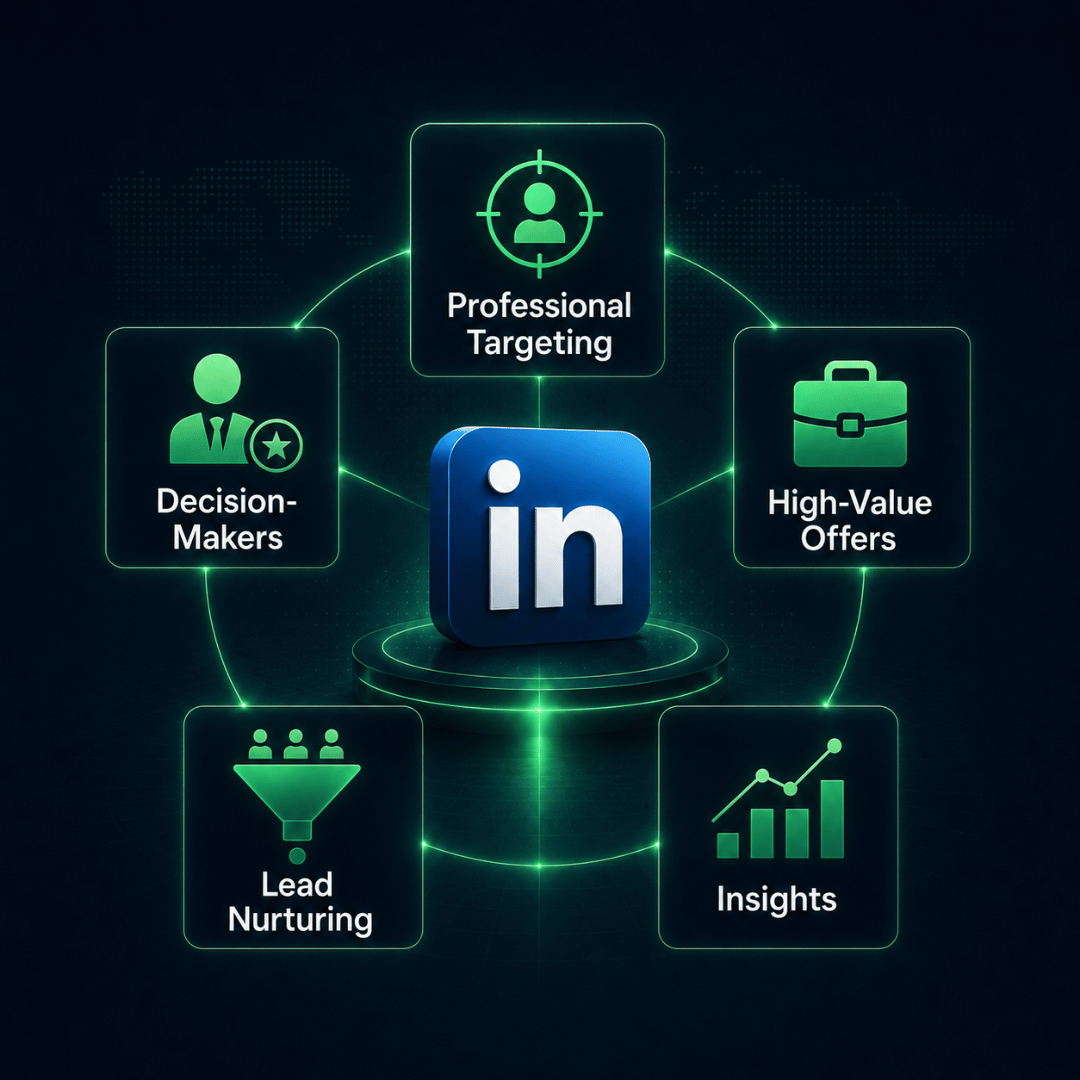
Pros of LinkedIn Ads for B2B Businesses Should Understand
LinkedIn Ads can offer several advantages for B2B businesses when the campaign is planned properly. The main value is not only visibility, but the ability to reach more relevant professional audiences with a clearer business context. The table below summarises the pros of LinkedIn Ads from a business-fit perspective.
| Advantage | What It Means for B2B Businesses |
| Precise professional targeting | Businesses can reach audiences based on role, seniority, industry, company type, location, or business responsibility. |
| Stronger business context | LinkedIn users are usually in a more professional mindset, making B2B messages more relevant. |
| Better fit for high-value offers | LinkedIn Ads may be more suitable when the product or service value can justify higher lead costs. |
| Supports lead generation and nurturing | Businesses can use LinkedIn Ads to build awareness, promote content, capture leads, and retarget warm audiences. |
| Improves campaign learning | Campaign data can help businesses understand which audiences, messages, and offers attract better-quality prospects. |
These advantages are useful when the business already understands who it wants to reach and what kind of action it wants the audience to take.
For example, a company may use LinkedIn Ads to reach HR managers for a corporate training offer, finance leaders for advisory services, or SME founders for business growth solutions. In these cases, the campaign does not need to reach everyone. It needs to reach the right type of people.
This makes LinkedIn Ads especially useful for B2B campaigns where lead quality matters more than traffic volume.
Cons of LinkedIn Ads for B2B Businesses Should Understand
Although LinkedIn Ads can be useful, businesses should also understand its limitations before investing. These limitations do not mean the platform is weak. They simply mean LinkedIn Ads need the right business fit and preparation.
| Limitation | What Businesses Should Consider |
| Higher budget requirement | LinkedIn Ads may have higher CPC or CPL, so businesses should evaluate cost based on lead quality and sales value. |
| Longer lead maturity | B2B leads may need nurturing, internal discussion, and follow-up before they become real opportunities. |
| Funnel readiness matters | A weak landing page, unclear offer, or slow follow-up process can reduce campaign effectiveness. |
| Targeting alone is not enough | Even precise targeting will not work well if the message, creative, or offer is weak. |
| Smaller audiences may limit scale | Niche B2B audiences can be harder to scale and may need regular creative or message refreshes. |
The key point is that LinkedIn Ads should not be judged only by cheap clicks or fast conversions. For many B2B businesses, the real question is whether the campaign can attract the right prospects and support the sales process. A higher cost per lead may still be acceptable if the leads are relevant and the potential deal value is strong. However, it may not be suitable for businesses that need very low-cost, high-volume leads or instant sales from cold traffic.
LinkedIn Ads for B2B May Work Well When vs May Not Be Suitable Yet
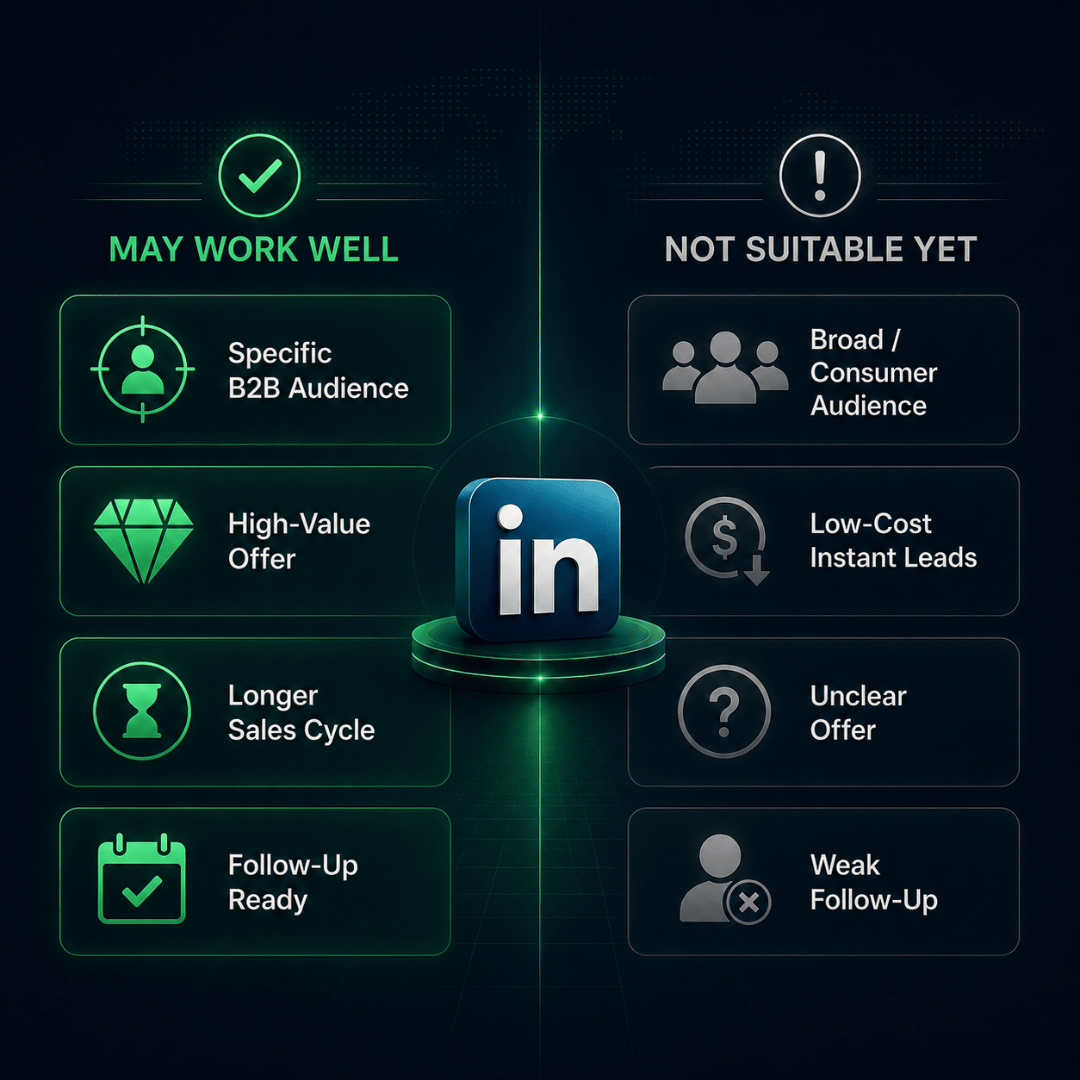
The pros and cons of LinkedIn Ads should be evaluated based on business fit. LinkedIn Ads may be a strong channel for one B2B company, but not the best starting point for another.
| LinkedIn Ads May Work Well When | LinkedIn Ads May Not Be Suitable Yet When |
| You target specific B2B decision-makers | Your audience is too broad or mostly consumer-focused |
| Your offer has higher contract value | You need very low-cost instant conversions |
| Your buyers take time to evaluate solutions | You expect fast sales from cold traffic |
| Your sales team can follow up properly | Your lead handling process is weak |
| Your landing page or lead form is clear | Your offer or funnel is still unclear |
| You can measure lead quality and pipeline | You only track clicks and impressions |
| You are ready to test and optimise | You expect one campaign to work immediately |
This comparison helps businesses avoid choosing LinkedIn Ads just because it is popular in B2B marketing. The platform works better when the audience, offer, funnel, and follow-up process are already aligned.
When LinkedIn Ads Makes More Sense Than Other Paid Channels
LinkedIn Ads may make more sense when audience quality matters more than traffic volume.
For example, if your business needs to reach specific job roles, senior decision-makers, professional segments, or high-value B2B buyers, LinkedIn may be more suitable than broader paid social channels.
LinkedIn Ads can be a better fit when:
- Your target audience is clearly defined by role, industry, seniority, or company type
- Your product or service is business-related
- Your offer is high-value enough to justify higher lead costs
- Your sales cycle involves evaluation, nurturing, or consultation
- Your campaign needs professional context
- Your team wants to build a B2B lead generation pipeline, not just traffic
This is especially relevant for businesses selling services where trust, authority, and business fit matter before the prospect is ready to enquire.
However, LinkedIn Ads does not need to replace other channels. In many cases, it can support a wider marketing mix. A business may use Google Ads for high-intent search demand, SEO for long-term discovery, email marketing for nurturing, and LinkedIn Ads for targeted B2B audience development.
The right channel depends on the business objective.
When LinkedIn Ads May Not Be the Best Fit Yet
LinkedIn Ads may not be the best fit if the business is not ready to support the full lead generation journey.
For example, if the offer is unclear, the landing page is weak, the sales team is not ready, or there is no follow-up process, the campaign may generate interest without strong business outcomes.
LinkedIn Ads may not be suitable yet when:
- Your business does not know who the ideal customer is
- Your offer is still too broad or unclear
- Your budget expectation is too low for B2B testing
- You need instant low-cost conversions
- Your landing page does not support the campaign message
- Your team cannot follow up with leads properly
- You are not ready to measure lead quality
- You only want impressions or clicks without a proper next step
This does not mean the business should never use LinkedIn Ads. It may simply mean the business should prepare the foundation first.
For some companies, improving the offer, landing page, tracking, or sales process may be more important before launching LinkedIn campaigns.
What Businesses Should Prepare Before Running LinkedIn Ads
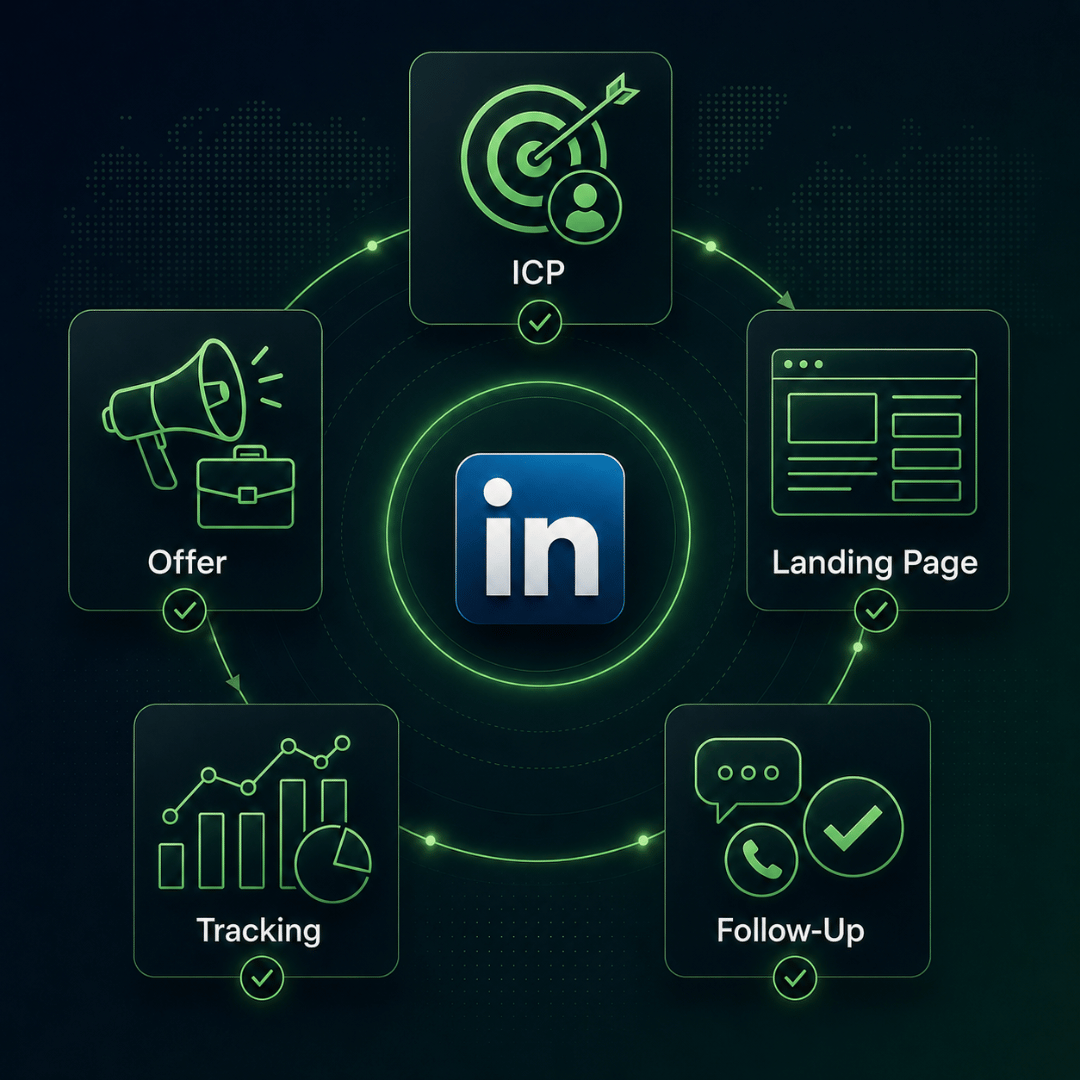
Before running LinkedIn Ads, businesses should prepare the key elements that affect campaign performance. This helps reduce wasted budget and gives the campaign a clearer direction from the beginning.
| What to Prepare | Why It Matters |
| Clear ideal customer profile | Helps avoid broad or shallow targeting and keeps the campaign focused on the right audience. |
| Strong offer or campaign angle | Gives the audience a clear reason to respond, such as a guide, consultation, demo, audit, or assessment. |
| Landing page or lead form readiness | Ensures users understand the offer and know what action to take after clicking the ad. |
| Tracking and reporting setup | Helps measure leads, CPL, conversion rate, lead quality, and sales feedback beyond clicks. |
| Follow-up process | Ensures B2B leads are handled properly after they submit an enquiry or form. |
This preparation stage is important because LinkedIn Ads is not only about reaching the right people. The campaign also needs to guide them toward the right next step.
A business may reach the right audience but still lose opportunities if the offer is unclear, the landing page does not build trust, or the sales team follows up too slowly.
Explore our LinkedIn Advertising Service in Malaysia to understand how we help B2B businesses evaluate channel fit, prepare the right funnel, and plan LinkedIn campaigns with clearer lead quality tracking.
How to Decide Whether LinkedIn Ads Is Right for Your B2B Strategy
The best way to decide whether LinkedIn Ads is right for your business is to evaluate your audience, offer, sales cycle, budget, and follow-up readiness.
Ask these questions before investing:
- Are our target buyers active or reachable on LinkedIn?
- Do we know our ideal customer profile clearly?
- Is our offer strong enough for a B2B audience?
- Do we have a landing page or lead form that supports the campaign?
- Can our team follow up with leads properly?
- Are we ready to measure lead quality, not just lead quantity?
- Does our product or service value justify the expected lead cost?
- Are we willing to test and optimise over time?
If most answers are yes, LinkedIn Ads may be a suitable channel to test or scale. If many answers are unclear, it may be better to strengthen the foundation first.
For B2B businesses, LinkedIn Ads often works best when the business is not only looking for visibility, but also wants to build a more targeted lead generation system.
Ready to Evaluate Your LinkedIn Lead Generation Approach?
LinkedIn Ads can be valuable for B2B businesses, but it should be used with the right expectations.
The platform is not suitable for every business, and it should not be treated as a shortcut to instant leads. It works best when the audience is specific, the offer is clear, the funnel is ready, and the business can measure lead quality properly.
Before investing more budget, take time to evaluate the pros and cons of LinkedIn Ads based on your business model, sales process, and lead generation goals.
Speak to our team about whether LinkedIn Ads is right for your business and how to prepare a stronger B2B lead generation approach.