How effective is Facebook advertising for generating awareness, enquiries and sales? Its effectiveness depends on whether the campaign reaches the right audience, produces the intended action and delivers meaningful results at an acceptable cost.
However, impressions, clicks and engagement do not automatically indicate success. A campaign may appear active in Meta Ads Manager while producing few qualified enquiries, purchases or other valuable outcomes. Businesses that need additional support analysing and improving these results may work with a Facebook Marketing Company to strengthen campaign strategy, optimisation and performance.
This guide explains how to evaluate Facebook Ads performance, diagnose weak results, improve the campaign and determine whether it is ready to scale.
How Effective Is Facebook Advertising?
Yes, Facebook Ads can support objectives such as brand awareness, website traffic, engagement, lead generation and sales. Their effectiveness depends on how well the campaign objective, audience, offer, creative, destination and tracking work together.
The correct way to evaluate a campaign is to compare its results with the original business goal.
For example, an awareness campaign should not be assessed only by sales. Similarly, a lead-generation campaign should not be considered successful simply because it generated many clicks.
A campaign is effective when:
- It produces the intended result.
- The cost of that result is commercially acceptable.
- The result creates meaningful value for the business.
Low-cost results are not valuable if they do not contribute to the intended business outcome.
What Does an Effective Facebook Ads Campaign Look Like?
When assessing how effective is Facebook advertising, businesses should compare campaign results with the original objective, acceptable cost and quality of the outcomes generated. An effective campaign creates a clear connection between its advertising objective and the desired result.
For example:
- An awareness campaign reaches the intended market efficiently.
- A traffic campaign attracts relevant visitors who successfully reach the destination.
- A lead campaign generates enquiries that the sales team can contact and qualify.
- A sales campaign produces purchases at a sustainable acquisition cost.
- A messaging campaign starts relevant customer conversations.
Before launching the campaign, define:
- The primary business objective
- The main campaign result
- The acceptable cost per result
- The required lead or sale quality
- The supporting performance metrics
- The period used for evaluation
Defining these factors early prevents advertisers from judging success based only on whichever metric appears most positive later.
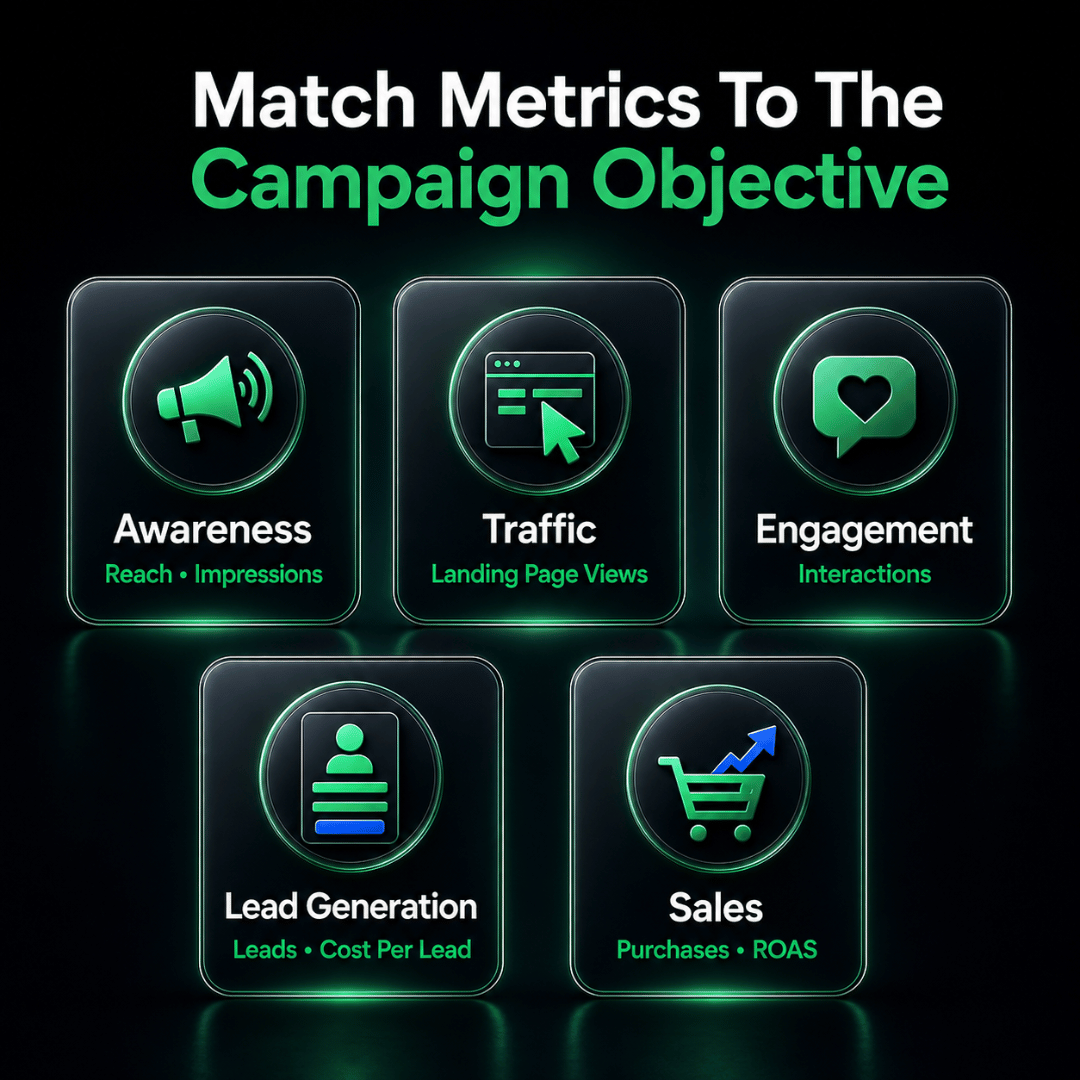
Match Facebook Ads Metrics to the Campaign Objective
Meta Ads Manager provides many metrics, but they do not carry equal importance. The primary metric should represent the intended outcome, while supporting metrics help explain why the result is strong or weak.
| Campaign Goal | Primary Metrics | Supporting Metrics |
| Awareness | Reach and impressions | Frequency and CPM |
| Website traffic | Landing-page views or relevant website sessions | CTR, CPC and landing-page-view rate |
| Engagement | Relevant interactions, video views or conversations | Engagement rate and cost per result |
| Lead generation | Leads and cost per lead | Qualification rate, contact rate and appointment rate |
| Sales | Purchases, cost per purchase and revenue | Conversion rate, ROAS and average order value |
For example, a campaign may generate leads at a low cost but still perform poorly if most submissions are invalid or do not match the intended customer.
Another campaign may have a higher cost per lead but deliver better-qualified enquiries that are more likely to become customers.
Which Facebook Ads Metrics Should You Monitor?
Understanding how effective is Facebook advertising requires more than checking impressions or clicks. Delivery, response, conversion and business-quality metrics should be evaluated together.
| Metric | What It Measures | What to Check |
| Results | Number of intended actions recorded | Whether the reported result matches the real objective |
| Cost per result | Average advertising cost for each result | Whether the result is valuable enough to justify the cost |
| Reach | Estimated number of people who saw the advertisement | Whether the campaign is reaching enough of the intended market |
| Impressions | Total number of times advertisements were displayed | How much overall exposure the campaign generated |
| Frequency | Average number of times each person saw the advertisement | Whether repeated exposure is affecting response |
| CPM | Cost for every 1,000 impressions | Whether audience delivery is becoming more expensive |
| CTR | Percentage of impressions that generated clicks | Whether the creative and message attract attention |
| CPC | Average cost for each click | Whether the campaign attracts traffic efficiently |
| Conversion rate | Percentage of visitors who completed the intended action | Whether the destination turns interest into results |
| Cost per lead or acquisition | Average cost of generating a lead, purchase or other valuable action | Whether the result is commercially sustainable |
| ROAS | Revenue attributed to advertising divided by advertising spend | Whether attributed revenue supports the advertising cost |
For platform-level reporting, Meta provides guidance on how to view and analyse ad results in Meta Ads Manager at the campaign, ad-set and individual-ad levels. These metrics must be interpreted together.
A high CTR with few conversions may indicate attractive creative but a weak landing experience. A low cost per lead may appear positive until the sales team confirms that the enquiries are poorly qualified.
There is also no universal “good” cost or rate. Suitable performance depends on the campaign objective, industry, audience, customer value and profit margin.
Why Clicks Do Not Always Become Quality Visits
A link click only confirms that someone clicked. It does not necessarily mean the destination loaded successfully or that the visitor engaged with it.
| Metric | What It Indicates |
| Link clicks | People clicked a link connected to the advertisement |
| Landing-page views | The destination loaded after the click |
| Website sessions | The analytics platform recorded a visit |
| Engaged sessions | Visitors met the platform’s engagement criteria |
| Conversions | Visitors completed the intended action |
A large difference between link clicks and landing-page views may indicate:
- Slow page loading
- Accidental clicks
- Broken links
- Tracking problems
- Visitors leaving before the page loads
Website analytics can provide another layer of evidence. Review engaged sessions, time spent, form starts, form completions, add-to-cart actions, purchases and device performance.
A campaign should not be judged only through Meta reporting when the intended result happens on a website, in a CRM or through an offline sales process. This comparison provides a clearer answer to how effective is Facebook advertising at attracting visitors who complete meaningful actions after clicking.
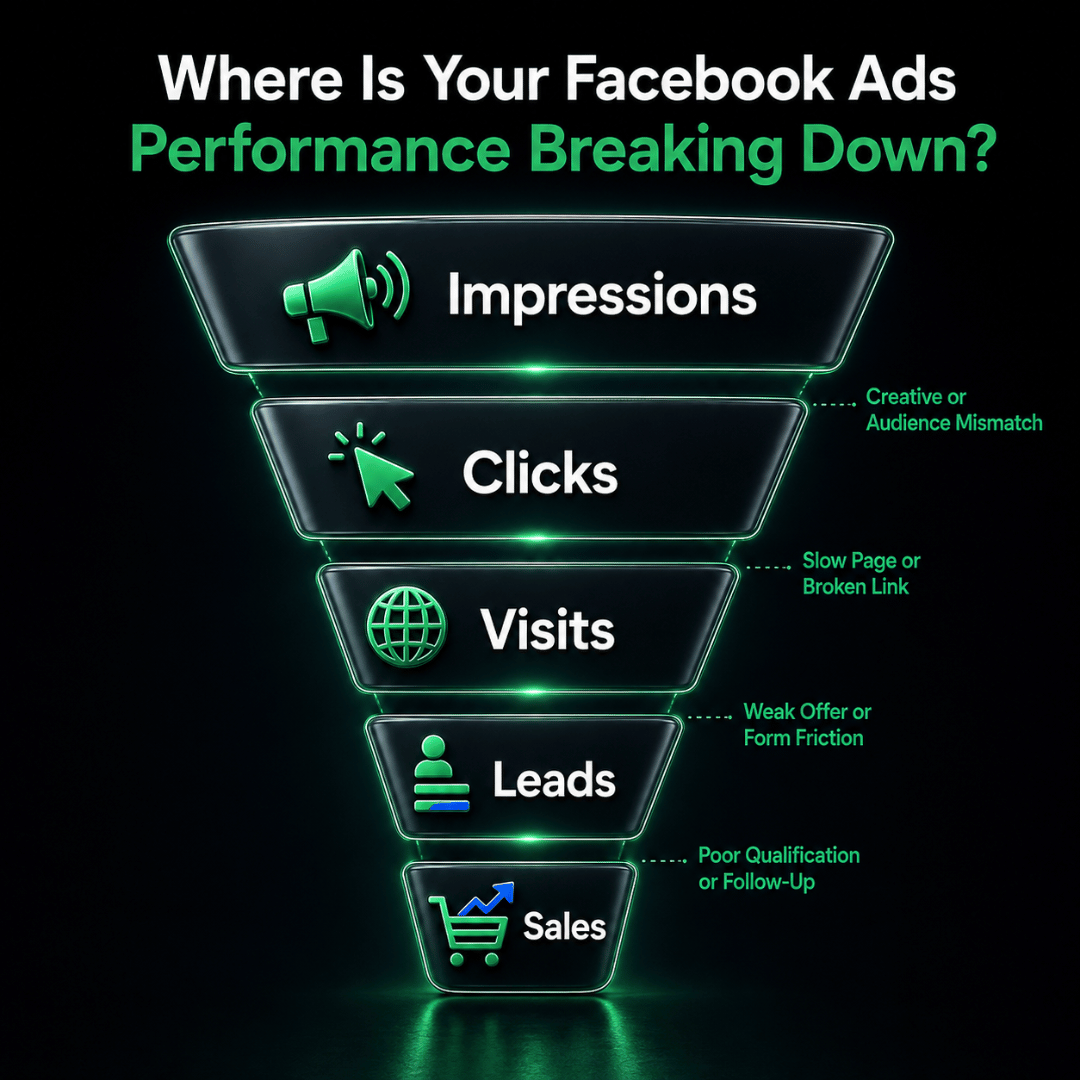
Why Are Facebook Ads Getting Clicks but No Enquiries or Sales?
When advertisements generate clicks without meaningful business outcomes, the problem may occur at several points in the customer journey. To determine how effective is Facebook advertising, review each stage between the initial impression and the final enquiry, purchase or other business outcome.
The Campaign Objective Does Not Match the Goal
A traffic campaign is designed to find people likely to visit a destination. It is not necessarily designed to find people most likely to submit a form or purchase.
When the intended outcome is a lead or sale, the objective and performance goal should reflect that result whenever suitable tracking is available.
The Audience Is Not Qualified
An advertisement may attract attention from people who enjoy the content but do not match the intended customer profile.
The creative and wording should clearly communicate:
- Who the offer is for
- The relevant location
- The problem being solved
- Important eligibility conditions
- The expected price or commitment, when appropriate
Clearer qualification may reduce the total number of clicks while improving the quality of the remaining traffic.
The Advertisement and Destination Do Not Match
The destination should continue the same message, offer and expectation established in the advertisement.
Conversions may decline when:
- The advertisement promotes a different offer.
- Important information is difficult to find.
- The call to action creates the wrong expectation.
- The form requests too much information.
- The website is slow or difficult to use on mobile.
Test the complete journey on an actual mobile device, from the advertisement click to the final confirmation.
The Offer Is Not Convincing
The audience may understand the advertisement without finding the offer valuable enough to act upon.
Common problems include an unclear benefit, weak differentiation, missing trust signals, uncertain terms or a complicated next step.
Campaign optimisation cannot fully compensate for an offer that the intended audience does not want.
Tracking or Follow-Up Is Weak
A campaign may generate results that are not recorded correctly, or it may optimise towards the wrong event.
Confirm that the intended event activates at the correct stage, the correct dataset is connected and duplicate events are not counted. Compare Meta results with website analytics, form submissions and sales records.
Lead-generation performance also depends on what happens after submission. Qualified enquiries may still be lost when the response is slow, follow-up is inconsistent or sales outcomes are not recorded.
How to Improve Facebook Ads Performance
Improving how effective is Facebook advertising begins with identifying the weakest stage of the campaign journey instead of changing every setting simultaneously.
1. Confirm the Primary Business Metric
Choose one main metric that represents the intended outcome, such as:
- Cost per qualified lead
- Cost per appointment
- Cost per purchase
- Revenue or ROAS
- Cost per relevant conversation
Supporting metrics should help explain changes in this primary result.
2. Diagnose the Campaign Funnel
Review the customer journey in order:
- Limited delivery: Check the account status, schedule, budget, audience and delivery warnings.
- Reach but weak response: Review the creative, opening message, offer and audience relevance.
- Clicks but few landing-page views: Check the link, page speed and mobile loading.
- Visits but few conversions: Review the offer, destination, form and trust signals.
- Leads but weak sales: Review qualification, response time and sales follow-up.
- Reported results but unclear value: Improve tracking and connect advertising data with business outcomes.
This approach helps prevent unnecessary changes to parts of the campaign that may already be working.
3. Test One Meaningful Variable
Useful test variables include:
- Creative concept or format
- Opening message
- Headline
- Offer
- Audience
- Placement
- Destination
- Call to action
Changing several major variables simultaneously makes it difficult to determine which change affected performance.
Each test should have a clear hypothesis, one primary success metric and enough delivery to provide useful evidence.
4. Improve the Creative, Offer or Destination
If response declines as frequency increases, the audience may be experiencing creative fatigue.
Instead of changing only colours or minor design details, introduce a meaningful new angle, such as:
- A different customer problem
- A new product benefit
- A demonstration
- A testimonial
- A comparison
- A stronger opening scene
- A different creative format
When advertisements receive clicks but few conversions, improvements may also be needed outside Ads Manager.
Consider clarifying the benefit, matching the landing-page headline to the advertisement, reducing unnecessary form fields, improving mobile usability and adding relevant proof or trust signals.
5. Protect the Measurement Setup
Before making major budget decisions, confirm that the reported results represent real actions.
Compare Meta reporting with:
- Website analytics
- Form submissions
- Messaging records
- CRM data
- E-commerce orders
- Telephone enquiries
- Offline sales records
Differences between platforms can occur because attribution methods and reporting rules vary. The objective is not always to make every number identical, but to establish a consistent method for decision-making.
Avoid making repeated campaign changes without enough time to evaluate them. Maintain a simple change log recording what changed, why it changed, the metric expected to improve and the review date.
When Is a Facebook Campaign Ready to Scale?
Scaling should increase the campaign’s ability to produce more valuable results. It should not simply mean spending more money.
Another way to judge how effective is Facebook advertising is to check whether the campaign can maintain acceptable costs and result quality as its reach or budget increases. A campaign may be ready to scale when:
- It has generated enough results to evaluate.
- The cost per result is commercially acceptable.
- Lead or sale quality has been confirmed.
- Performance is reasonably consistent.
- Tracking is reliable.
- The audience still has room for delivery.
- Additional creative is available.
- The business can handle more enquiries or orders.
Do not scale based on one unusually strong day or a very small number of conversions.
How to Scale Facebook Ads Carefully
One option is to increase the budget of an existing campaign that has demonstrated stable performance. Monitoring how effective is Facebook advertising after each budget increase helps determine whether the campaign can generate more results without losing efficiency or quality.
After increasing it, monitor whether:
- Result volume increases
- Cost per result remains acceptable
- Lead or sale quality remains consistent
- Frequency rises too quickly
- Delivery shifts significantly
A larger budget does not guarantee that the same cost per result will continue.
Businesses may also scale by expanding what already works. This can include introducing new creative, testing another suitable audience, expanding to another eligible location or adding a proven offer.
Expansion should remain connected to the campaign’s original business objective.
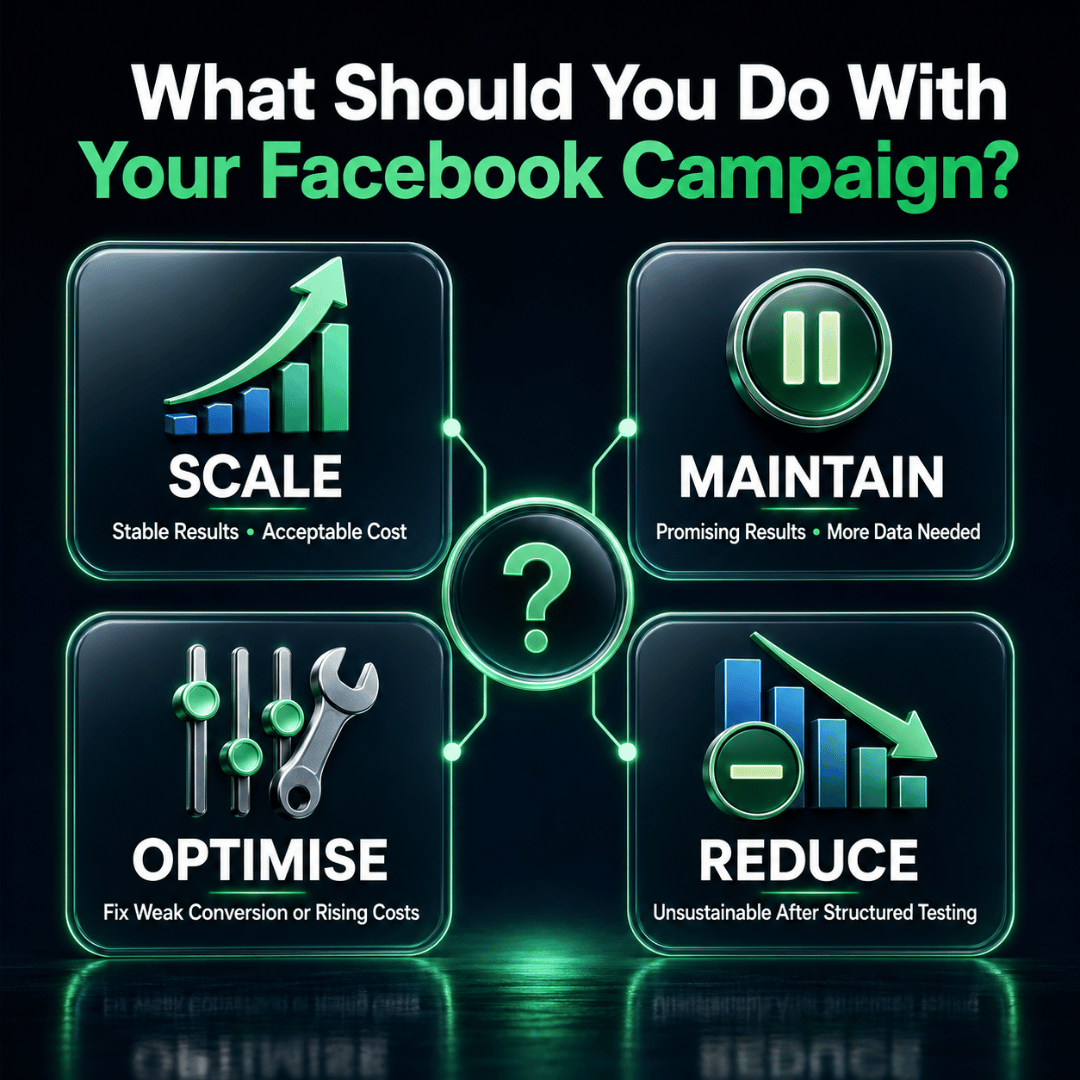
Should You Scale, Maintain, Optimise or Reduce the Campaign?
Use the available evidence to choose the next action. The answer to how effective is Facebook advertising should guide whether the campaign is scaled, maintained, optimised or reduced.
| Campaign Situation | Recommended Direction |
| Results and quality are stable at an acceptable cost | Consider controlled scaling |
| Results are acceptable but data remains limited | Maintain the campaign and collect more evidence |
| Clicks are strong but conversions are weak | Improve the offer, destination or tracking |
| Leads are inexpensive but poorly qualified | Refine the messaging, qualification and follow-up |
| Costs rise while frequency increases | Refresh the creative or review the audience |
| Tracking is unreliable | Fix measurement before changing the budget |
| Results remain commercially unsustainable after structured testing | Reduce or stop the weak activity and reassess the strategy |
The final decision should reflect business economics rather than one isolated platform metric.
Improve Facebook Ads Based on Business Results
So, how effective is Facebook advertising? They can be, but effectiveness should be measured through meaningful business outcomes rather than surface-level activity.
Start with the intended result. Then evaluate delivery, audience response, destination performance, conversion quality and commercial value.
When performance is weak, identify where the customer journey is breaking before making changes. Test improvements systematically, protect the measurement setup and scale only when the results are sufficiently consistent.
If you need to build or restructure your campaign first, follow our Facebook Ads Manager Tutorial.
For support with campaign strategy, creative, targeting, tracking and optimisation, explore Kawan Elite’s Facebook Advertising Services.
To discuss your campaign goals and current performance, contact the Kawan Elite team.