Instagram Stories move quickly. Users can tap from one Story to another within seconds, giving businesses only a short window to attract attention and communicate a message.
This is where ads in Instagram Stories appear. Story Ads are paid placements designed for Instagram’s vertical, mobile-first environment and can support objectives such as awareness, website traffic, enquiries, leads or sales.
Within a broader Instagram Advertising Malaysia strategy, Story Ads can be useful when businesses need a fast, visual placement that connects creative, audience targeting, call to action and destination around one clear campaign goal.
Instagram Story Ads are paid advertisements shown between the Stories people view on Instagram. Businesses create them through Meta Ads Manager by choosing a campaign objective, audience, placement, budget and creative. Users can respond through the ad’s call to action, while performance is measured according to the campaign goal.
Understanding how Instagram Story Ads work helps businesses decide whether this placement fits their wider campaign strategy.
What Are Instagram Story Ads and How Do They Work?
Instagram Story Ads are paid advertisements displayed as users move through Stories. They are designed to fit naturally within the full-screen vertical viewing experience.
Unlike organic Stories, which mainly depend on followers and Instagram’s organic distribution, Story Ads can be delivered to selected audiences through Meta’s advertising system.
A typical journey looks like:
Business Creates Ad → Audience Sees Story → User Responds to CTA → User Reaches Destination → Result Is Measured
Because people can quickly move to the next Story, the advertisement should communicate its main idea early.
Paid Story placements also include advertising indicators and may contain a call to action that directs users to a landing page, product page, lead form or another relevant destination.
Performance should then be evaluated according to the campaign objective. Awareness campaigns may focus on reach, while lead or sales campaigns should look further into conversions, cost per result and customer quality.
Instagram Story Ads vs Organic Stories
Story Ads and organic Stories may look similar, but they serve different purposes.
| Area | Organic Instagram Story | Instagram Story Ad |
| Distribution | Mainly organic audience | Paid audience delivery |
| Audience control | Limited | Campaign-based targeting |
| Purpose | Content and community communication | Defined advertising outcome |
| CTA | Depends on organic features | Campaign-related CTA |
| Measurement | Organic Story insights | Advertising performance metrics |
| Publishing | Published to the account | Can be created specifically as an ad |
An Instagram Story Ad does not always need to be published organically first. Businesses can create placement-specific assets directly for their campaigns.
This also differs from simply boosting existing Instagram content. A structured campaign through Meta Ads Manager gives businesses greater control over audiences, placements, creative and measurement.
When Should Businesses Use Instagram Story Ads?
Instagram Story Ads may work well when the campaign message can be communicated quickly and visually.
| Business Goal | How Story Ads Can Support It |
| Product or service awareness | Introduce the offer through short, visual messaging |
| New outlet or event promotion | Build awareness and direct users towards more information |
| Website traffic | Encourage users to visit a relevant landing page |
| Lead generation | Move interested users towards an enquiry or lead form |
| Limited-time promotion | Communicate urgency and a clear CTA |
| Retargeting | Reconnect with previous website visitors or social media engagers |
| Wider Meta campaign | Add a vertical placement alongside Feed or other ad formats |
Stories are most suitable when users can understand the main offer within a few seconds. Campaigns requiring detailed explanations or complex comparisons may benefit from other placements or a combination of formats.
How to Create Instagram Story Ads in Meta Ads Manager
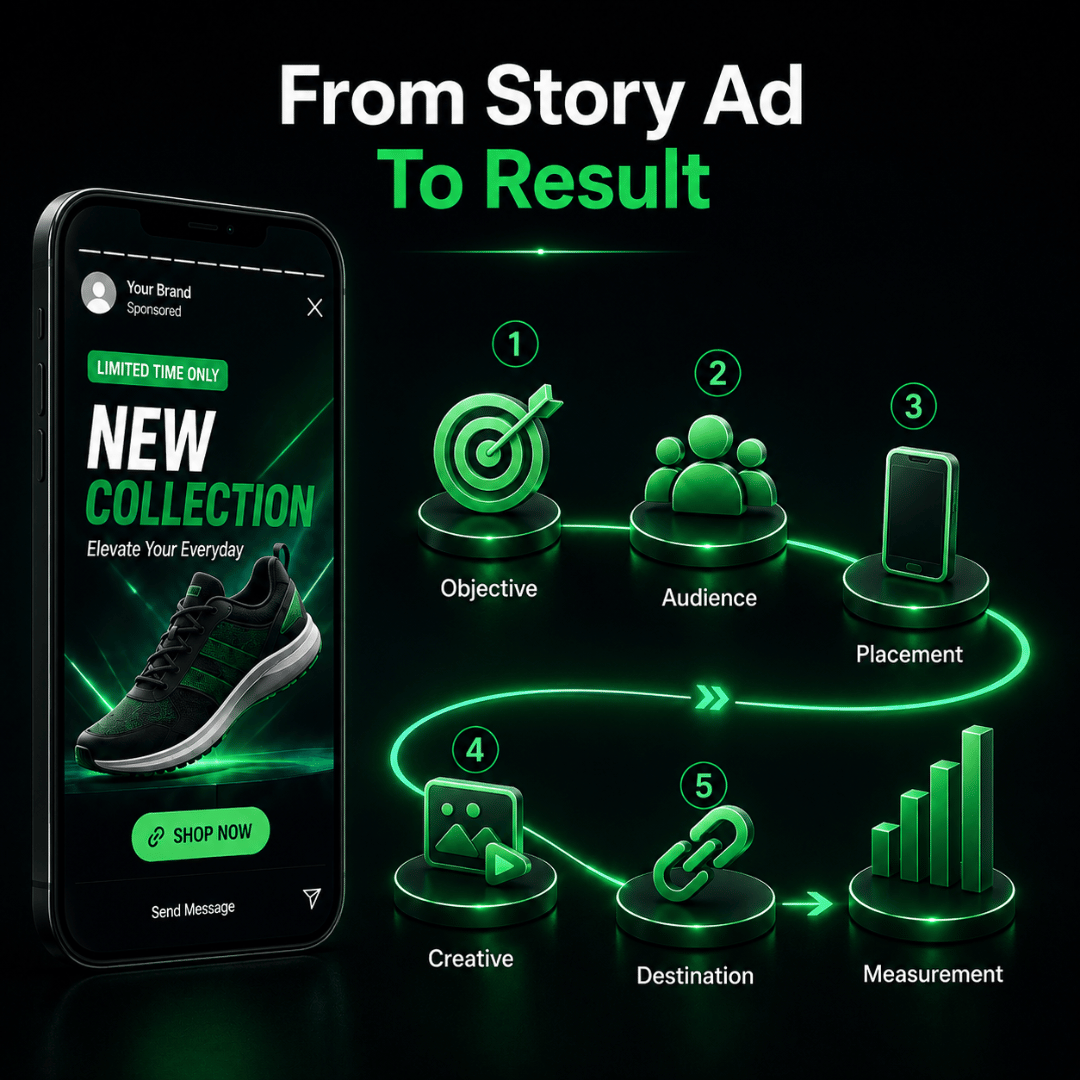
Creating Instagram ads in Stories should begin with the business outcome rather than the format itself.
Meta may change its menus and controls over time, so businesses should focus on the campaign logic instead of memorising specific buttons.
1. Choose the Campaign Objective
Define what the campaign needs to achieve, such as awareness, traffic, engagement, leads or sales.
The objective influences how Meta delivers and optimises the campaign.
2. Define the Audience
Choose an audience that is relevant to the offer.
For local businesses, location may be especially important. Reaching a smaller but relevant audience can be more useful than generating large numbers of impressions outside the service area.
3. Select the Story Placement
Instagram Stories may be included through automated placements or selected as part of a controlled placement strategy.
If Stories are important to the campaign, prepare vertical creative specifically for that environment.
4. Prepare the Creative
Use an image, video or other suitable format that communicates the message quickly and clearly.
The creative should support the campaign objective rather than simply look attractive.
5. Set the Destination, Budget and Review
Confirm where users should go after responding, then review the budget, campaign settings and destination before publishing.
The destination may be a landing page, product page, registration page, lead form or another relevant conversion point.
Instagram Story Ad Specifications and Safe Zones
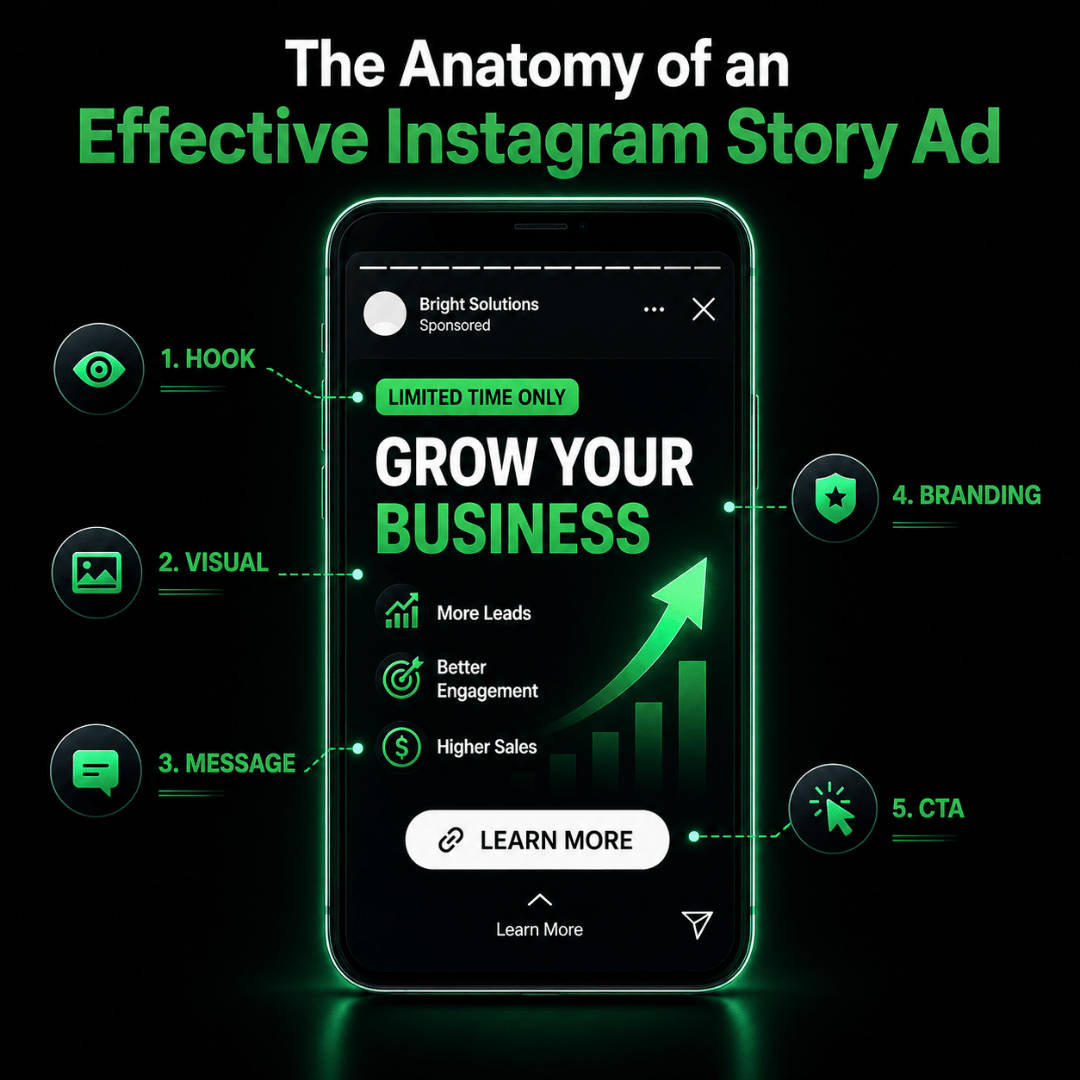
Story Ads are designed for a vertical, mobile-first environment.
A 9:16 aspect ratio is commonly used for full-screen Story creative, with 1080 × 1920 pixels being a practical production size.
However, dimensions alone do not make a good Story Ad.
Design Around the Instagram Interface
Instagram displays interface elements around Story content. Important information placed too close to the top or bottom may compete with account details, navigation controls or CTA elements.
Keep important content such as:
- Headlines
- Logos
- Product visuals
- Offers
- Key messages
within a comfortable central safe area.
The main message should remain easy to understand without requiring users to search around the screen.
Design Specifically for Stories
Avoid taking a square Feed ad and simply stretching or placing it inside a vertical layout.
Story creative should be designed for the placement from the beginning. Typography, composition, visual hierarchy and CTA positioning should all work naturally on a mobile screen.
Images may suit simple offers, while videos can create movement or demonstrate a product. The right format depends on the message and campaign goal rather than one universal rule.
What Makes an Effective Instagram Story Ad?
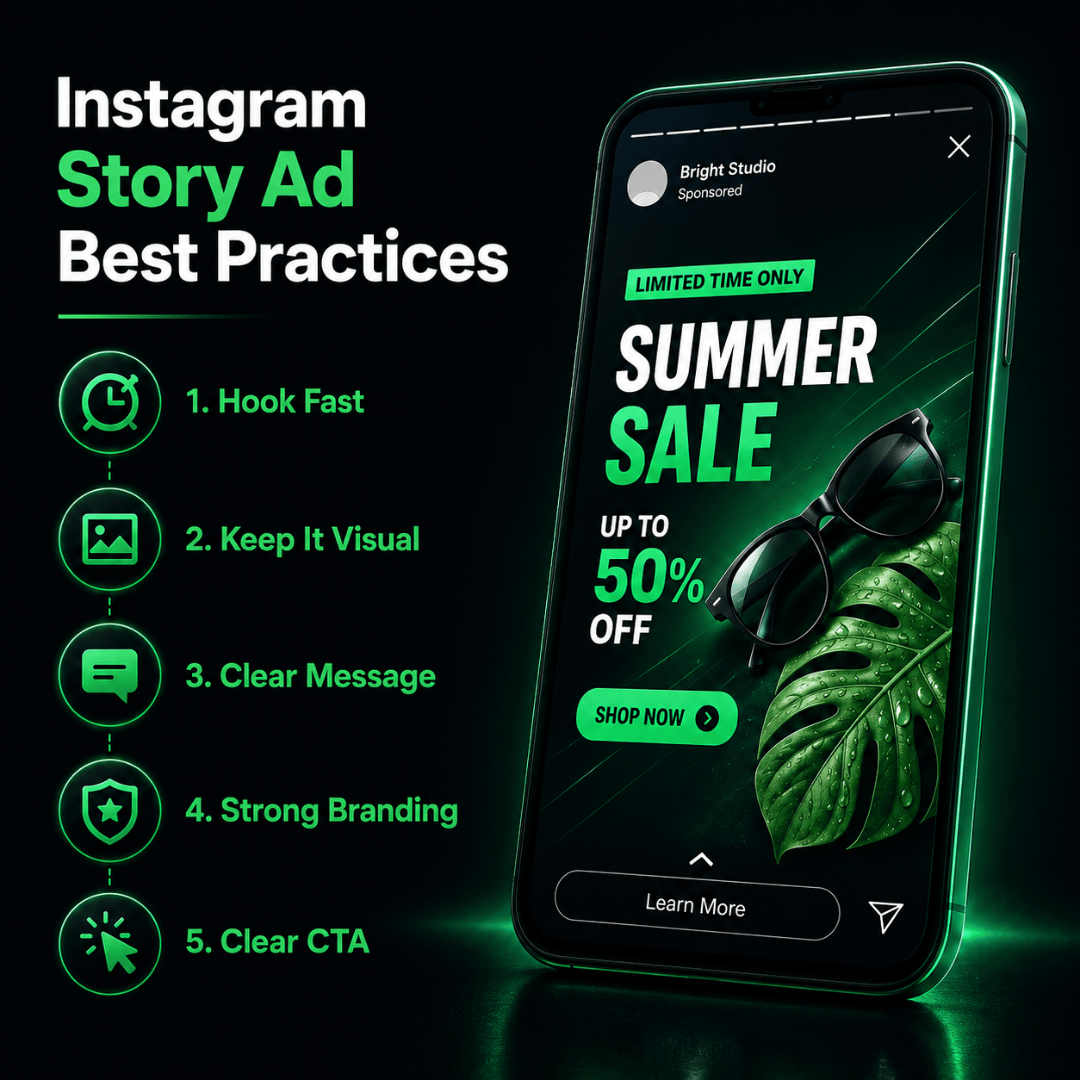
Because users can move to the next Story quickly, each creative element should have a clear role.
| Creative Element | Recommended Approach |
| Opening Hook | Communicate a problem, benefit, offer or relevant visual immediately |
| Main Message | Focus on one primary idea instead of adding too much information |
| Branding | Make the advertiser recognisable without overwhelming the offer |
| Visual | Design specifically for the vertical Story environment |
| CTA | Clearly show what the user should do next |
| Offer | Keep the value proposition easy to understand within a few seconds |
A simple Story structure is Hook → Main Message → Offer → CTA. Supporting details can be provided on the landing page after the user responds.
How to Connect Story Ads With the Landing Page
The Story Ad is only the beginning of the customer journey.
If someone responds to the advertisement but reaches an unrelated or confusing destination, the campaign may lose the attention it worked to generate.
A stronger journey looks like:
Story Creative → CTA → Relevant Landing Page → Conversion
The landing page should continue the same message and offer shown in the advertisement.
If the Story promotes a specific product, event or promotion, avoid directing users to a general homepage and expecting them to find it themselves.
Because Story users are already on mobile devices, the destination should also:
- Load quickly
- Display properly on mobile
- Keep the main offer visible
- Use readable text
- Make the next action easy
- Avoid unnecessary steps
The CTA and destination should also match. For example, an advertisement promising registration should lead directly towards registration rather than an unrelated information page.
What Should Businesses Measure?
The performance of ads in Instagram Stories should be measured according to the campaign objective, not through Story views alone.
| Campaign Goal | Main Metric | Supporting Metric |
| Awareness | Reach / Impressions | Video engagement |
| Traffic | Landing-page visits | CTR |
| Engagement | Relevant interactions | Cost per engagement |
| Leads | Qualified leads | Cost per lead |
| Sales | Purchases / Conversion value | Cost per purchase |
A high click-through rate may show that the Story attracted attention, but it does not prove that the landing page converted.
Similarly, a high number of leads may not be valuable if those enquiries are irrelevant.
Businesses should ask:
- Did the campaign reach the intended audience?
- Did users reach the destination?
- Did they complete the desired action?
- Were the resulting leads or customers relevant?
- Was the cost reasonable for the result?
For campaigns involving websites, enquiries or sales, measurement should continue beyond Instagram.
Common Instagram Story Advertising Mistakes
Taking Too Long to Reach the Message
Users can move to another Story quickly. Introduce the main idea early instead of relying on a long build-up.
Adding Too Much Text
Too much copy makes the advertisement difficult to understand within a short viewing window. Prioritise the message that matters most.
Ignoring Safe Zones
Important content positioned too close to interface elements may become difficult to see or reduce the clarity of the ad.
Reusing Feed Creative Without Adaptation
A square Feed advertisement placed inside a vertical Story may create wasted space and weak visual hierarchy. Design for the placement.
Measuring Views Instead of Business Outcomes
Views are useful for some awareness campaigns, but leads, purchases or conversion quality should matter more when those are the campaign objectives.
How to Test and Improve Instagram Story Ads
The first creative does not need to become the permanent version.
Businesses can test meaningful variations such as:
- Opening hook
- Product or lifestyle visual
- Headline
- Offer presentation
- CTA
- Audience
- Landing-page message
Where practical, change one important element at a time so the result provides a clearer lesson.
For growing businesses, structured testing can help identify which Story concept deserves more budget instead of scaling an advertisement simply because it generated views or clicks.
Instagram Story Ad Pre-Launch Checklist
Before launching, review the full customer journey.
| Check | What to Confirm |
| Campaign objective | Matches the intended outcome |
| Audience | Relevant to the offer and location |
| Story format | Designed vertically |
| Opening frame | Communicates the idea quickly |
| Message | One clear primary message |
| Branding | Visible but not distracting |
| Safe zones | Important elements remain clear |
| CTA | Matches the intended action |
| Destination | Relevant and mobile-friendly |
| Tracking | Required measurement prepared |
| Final review | Creative, links and settings checked |
This checklist helps prevent small creative or setup issues from affecting campaign performance once the advertising budget begins spending..
Final Takeaway
Instagram Story Ads give businesses access to a fast-moving, full-screen advertising environment where attention can be gained or lost within seconds.
Effective ads in Instagram Stories are not simply vertical graphics. The campaign objective, audience, creative, CTA, destination and measurement approach should all support the same outcome.
Design specifically for Stories, communicate the message quickly and make sure the landing page continues the journey started by the advertisement.
Explore Our Instagram Advertising Services to understand how campaign strategy, creative direction, tracking and optimisation can work together across Instagram placements.
For businesses planning a Story campaign around leads, sales, registrations or other measurable outcomes, Plan Your Instagram Story Advertising Campaign With Us.