Banner advertising uses visual ads across websites, mobile apps and digital platforms to promote a product, service, offer or campaign. However, the banner is only one part of the journey. Targeting, placements, message clarity, landing-page quality and tracking all influence whether the campaign produces meaningful results.
Businesses that need campaign-ready creative may also work with a banner design company to keep messaging, branding and advertising assets consistent across different placements.
What Is Banner Advertising?
Banner advertising is a form of digital advertising that uses visual ads to promote a brand, product, service or offer across websites, apps and other online placements. When clicked, the banner usually directs the viewer to a landing page, product page, enquiry form or another campaign destination.
A banner commonly includes a headline, supporting message, image, brand elements, offer and call to action.
Banner ads are one type of display advertising, a broader category that also includes animated, responsive and other visual ad formats. In this article, “banners advertising” refers to digital banners rather than physical iklan banner used at buildings, roadsides or events.
How Does Banner Advertising Work?
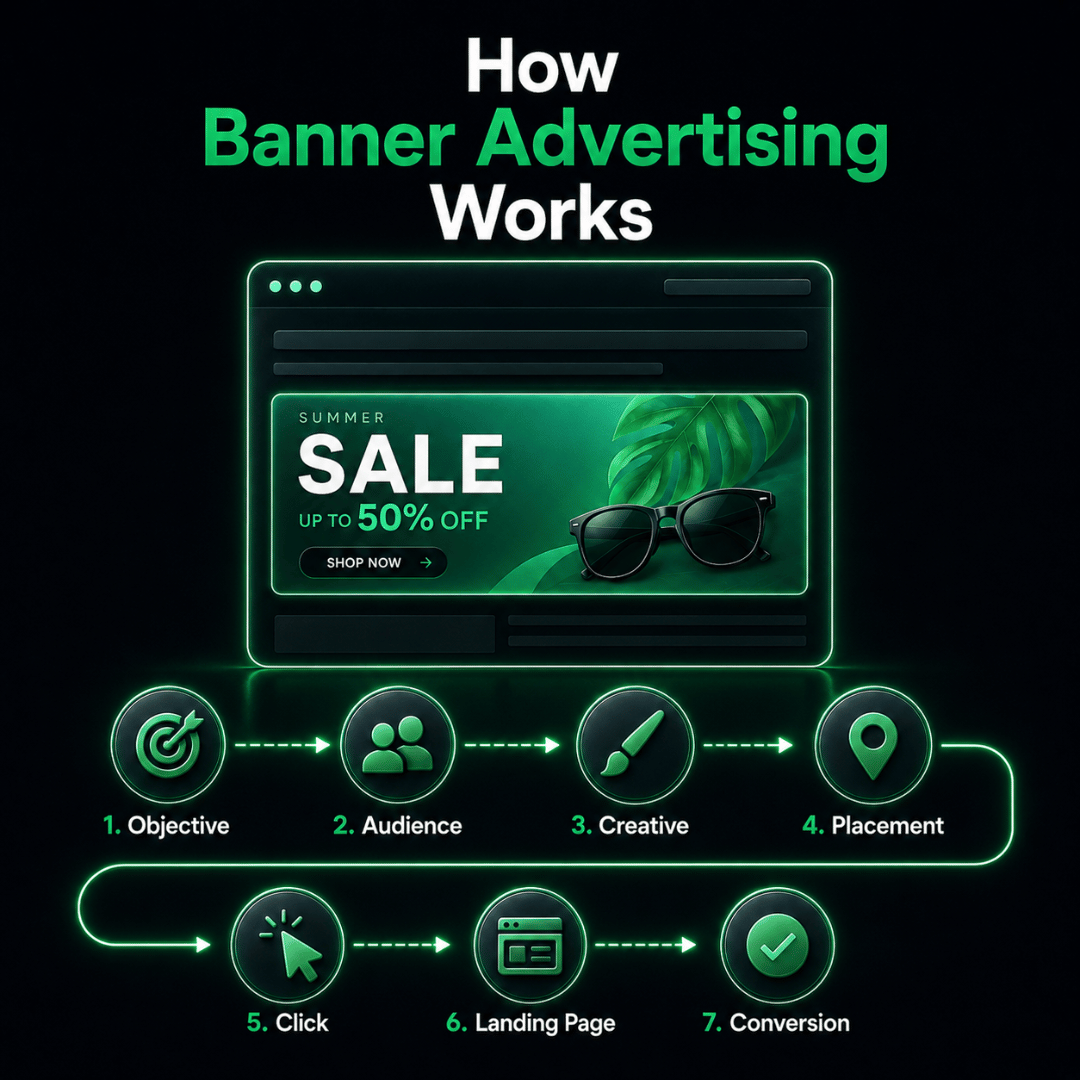
A banner campaign usually follows a connected journey from the initial objective to the measurement of results.
1. Define the Campaign Objective
Every campaign should begin with a clear objective. A business may want to build awareness, promote an offer, attract website visitors, generate enquiries, reconnect with previous visitors or support sales.
The objective influences the banner message, audience, call to action and destination page.
Without a clear objective, a banner may look professional but fail to guide the audience towards a useful next step.
2. Identify the Audience and Offer
The next step is deciding who should see the advertising banner and what should matter to them.
Audience planning may consider location, interests, industry, previous website activity and purchase intent.
The offer may involve a promotion, event, service or product launch. Because a banner has limited space, the main value should be clear without a long explanation.
3. Prepare the Message and Creative
Once the objective, audience and offer are clear, the banner creative can be prepared.
A practical information hierarchy is:
- What is being offered?
- Why should the viewer care?
- What should the viewer do next?
The banner does not need to explain every detail. Its role is to create enough interest for the viewer to continue.
The design should make the headline and action easy to recognise. Brand colours, product visuals and decorative elements should support the message rather than compete with it.
Different placements may also require different layouts. A wide website banner and a smaller mobile placement cannot always use the same arrangement.
4. Select the Platform and Placements
According to Google Ads, display campaigns can reach audiences across websites, apps and Google-owned properties such as YouTube and Gmail. Advertising banners can be distributed through platforms that provide access to websites, apps and other digital environments.
Placements may be selected through audience targeting, website topics, keywords, geographic targeting, remarketing lists, specific websites or automated optimisation. The placement should suit the objective and audience.
Visibility alone does not guarantee interest. A banner may receive many impressions but still perform poorly when the audience or context is not relevant.
5. The Platform Serves the Banner
After the campaign is configured, the advertising platform determines when and where the banner may appear. It may consider audience eligibility, targeting, budget, ad quality and placement availability.
Each time the advertisement is served, it records an impression. An impression shows visibility, but it does not confirm that the viewer noticed, understood or clicked the banner.
6. Viewers Click Through to the Destination
When someone finds the message relevant, they may click the banner.
The click may lead to a landing page, product page, online store, enquiry form, WhatsApp conversation, event registration page or store location page.
The destination should match the banner’s promise. A banner promoting a specific sale should not send visitors to a general homepage where they must search for the offer.
7. Measure and Improve the Campaign
The final stage is reviewing what happened after the banner was displayed.
Businesses can compare audiences, messages, placements and creative versions. Improvements may include testing a clearer headline, changing the call to action, excluding weak placements or improving the landing page.
Banner advertising is therefore not only a design task. It is a campaign process that can be measured and refined.
Where Can Advertising Banners Appear?
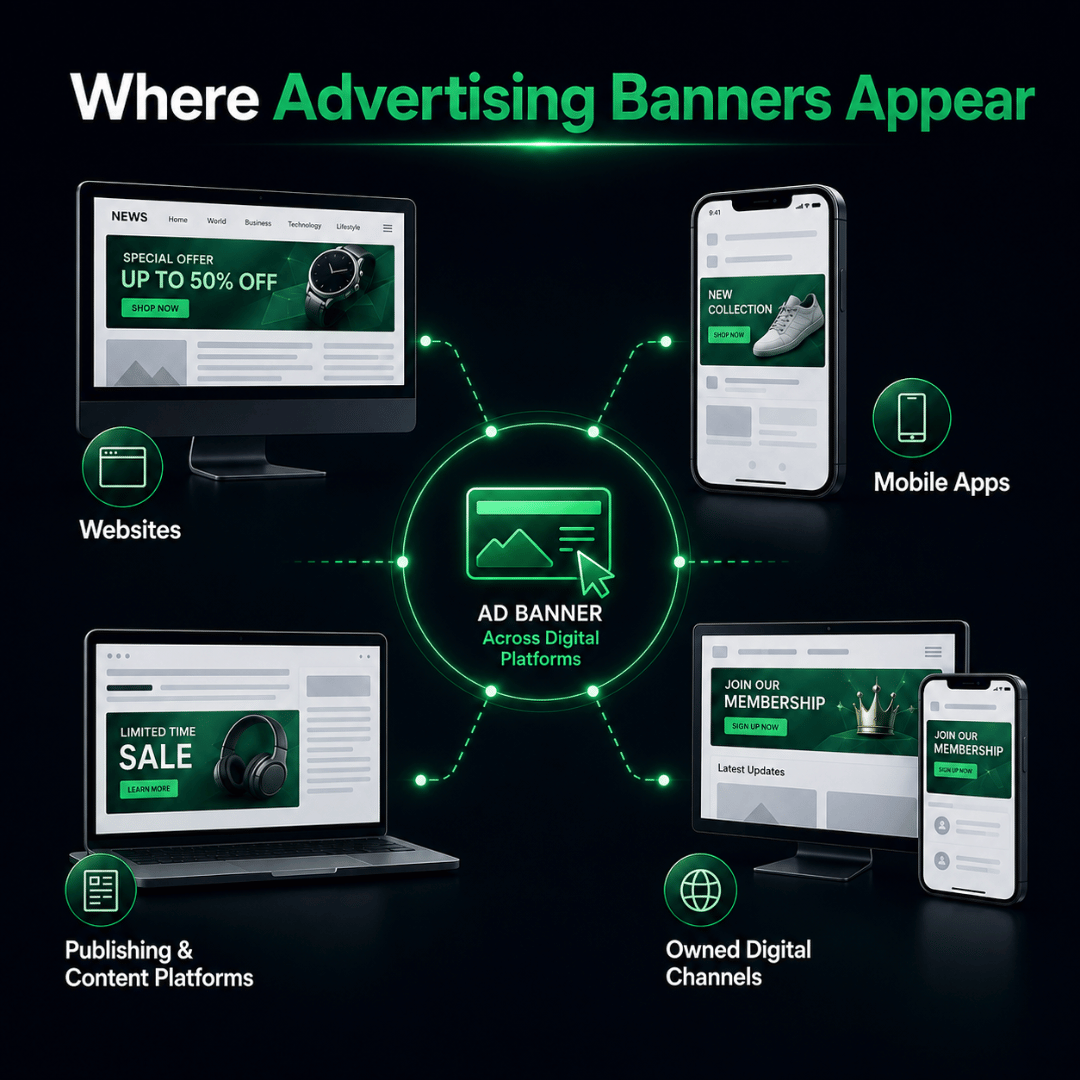
Digital advertising banners can appear across several online environments.
Websites and Publishing Platforms
Banners may appear at the top, side, middle or bottom of websites, including news sites, blogs and content platforms.
Mobile Apps
Mobile app banners commonly appear near the top or bottom of the screen or between content sections. The creative must remain readable on smaller displays.
Social and Digital Platforms
Digital platforms may label similar visual placements as image ads, display ads, sponsored placements or responsive creative. Each version should follow the platform’s requirements.
Owned Digital Channels
Businesses can also use banners on their own websites, portals and campaign pages to promote launches, events, announcements and seasonal offers.
What Can Banner Advertising Help Businesses Achieve?
Banner advertising can support several objectives depending on the offer, audience and setup.
| Campaign Objective | How Banner Advertising Supports It | Important Consideration |
| Build awareness | Introduces a brand, product, service or campaign to a wider audience through repeated visual exposure. | Awareness may not produce immediate enquiries or sales. |
| Promote offers and announcements | Highlights sales, outlet openings, product launches, events, deadlines and seasonal campaigns. | The main offer, deadline and CTA should be easy to recognise. |
| Generate website traffic | Directs interested viewers to a website, product page or campaign landing page. | Traffic is more valuable when visitors continue towards a meaningful action. |
| Support remarketing | Reconnects with people who previously visited a website or interacted with digital content. | The banner should provide a clear reason for the visitor to return. |
| Support enquiries and sales | Guides relevant audiences towards forms, WhatsApp, registrations, bookings or purchases. | Results also depend on the offer, landing page, targeting and follow-up process. |
Banner advertising can support different stages of the customer journey. However, the banner is the visual entry point rather than the entire conversion process.
Banner Advertising vs Other Digital Advertising Formats
Banner ads often work alongside search, social media, video and other formats.
| Advertising Format | Main Creative | Common Use | Typical Experience |
| Banner advertising | Static, animated or responsive visual | Awareness, promotions, traffic and remarketing | Appears while users browse websites or apps |
| Search advertising | Mainly text-based ads | Capture active demand | Appears when users search for relevant terms |
| Social media advertising | Images, carousels or videos | Discovery, engagement and conversions | Appears within feeds and stories |
| Video advertising | Short-form or long-form video | Awareness, demonstration and storytelling | Plays before, during or between content |
| Native advertising | Content-style creative | Discovery and consideration | Matches the surrounding platform or editorial layout |
Search advertising reaches users who are already looking for information. Banner advertising can reach audiences earlier while they are browsing.
A connected campaign may use several formats. Banner ads can introduce the campaign, search ads can capture demand and remarketing can reconnect with previous visitors.
What Happens After Someone Clicks a Banner Ad?
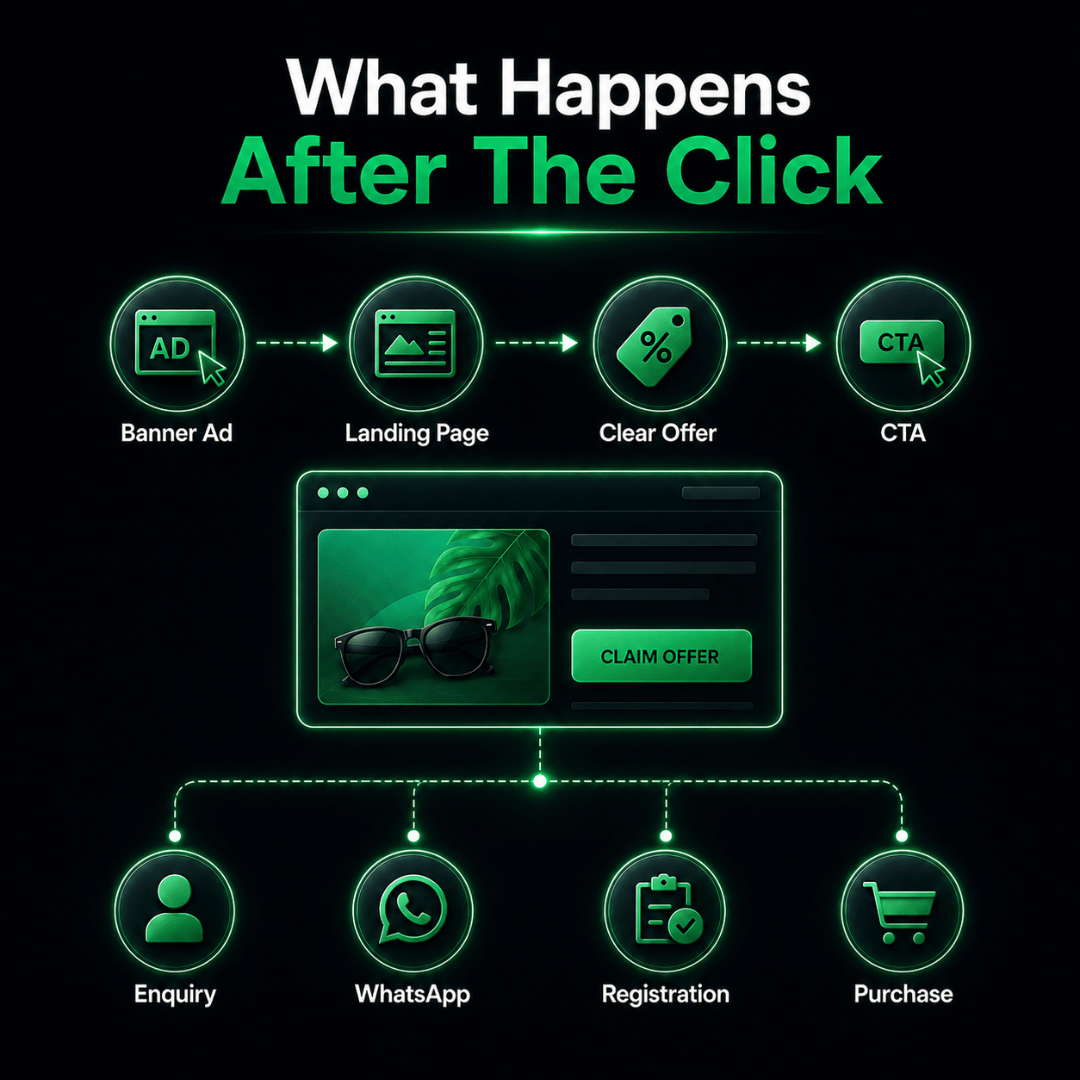
A click is the transition between the banner and the conversion experience. The destination page should continue the same offer, explain its value, build trust and guide the visitor towards the intended action.
A focused campaign landing page can maintain message consistency and reduce distractions.
When a campaign receives many clicks but few enquiries, registrations or purchases, the business should review the offer and landing-page experience rather than evaluating the banner alone.
How Do Businesses Measure Banner Advertising Performance?
The right measurements depend on the campaign objective.
| Metric | What It Measures | What Businesses Should Know |
| Impressions | The number of times the banner was served. | One person may generate several impressions. |
| Reach | The estimated number of individual users exposed to the banner. | Useful for understanding the scale of an awareness campaign. |
| Click-through rate | The percentage of impressions that resulted in clicks. | A strong CTR does not always mean the campaign generated conversions. |
| Conversions | The number of completed actions, such as enquiries, purchases, registrations or bookings. | The conversion action should be defined before the campaign begins. |
| Cost per conversion | The average advertising cost required to generate one conversion. | This is often more meaningful than evaluating low-cost clicks alone. |
| Return on ad spend | The revenue attributed to the campaign compared with advertising cost. | It is most useful when revenue tracking is reliable. |
Clicks ÷ Impressions × 100
CTR can indicate whether the audience and creative are generating interest, but it should not be the only measure of success.
No single metric explains the entire campaign. Businesses should evaluate performance according to the original objective and the quality of the actions generated.
When Might a Business Need Professional Banner Design?
Professional design becomes more valuable when:
- The campaign message is difficult to simplify
- Several banner versions are required
- Multiple platforms have different requirements
- Brand consistency must be maintained
- The campaign has a fixed deadline
- Internal teams have limited design capacity
- Existing creative does not communicate the offer clearly
Professional banner design helps translate a campaign objective into clear messaging, visual hierarchy and platform-ready creative, not simply a more attractive graphic.
Businesses preparing a larger campaign can explore Kawan Elite’s Banner Ads Design Services for support with campaign messaging, CTA direction and creative preparation.
What Should a Business Prepare Before Creating Advertising Banners?
A clear campaign brief can reduce revisions and improve the final creative.
Before designing a banner, prepare:
- Campaign objective: What should the campaign achieve?
- Target audience: Who should see the banner?
- Offer and benefit: What is being promoted, and why should people care?
- Call to action: What should viewers do next?
- Placement: Where will the banner appear?
- Destination: Where will viewers go after clicking?
- Brand assets: Which logos, colours and images should be used?
- Tracking and timeline: Which actions need to be measured, and when must the campaign launch?
Banner Advertising Works Best as Part of a Connected Campaign
Banner advertising can support awareness, promotions, website traffic, remarketing, enquiries and sales. However, its effectiveness depends on how well the objective, audience, message, placement, destination page and tracking work together.
The banner creates the first visual connection, while the rest of the campaign guides the audience towards a meaningful action.
Planning a digital campaign and need clearer messaging, CTA direction and platform-ready creative? Explore Kawan Elite’s Banner Ads Design Services to review the available support options.