

In today’s competitive environment, having an online presence is no longer enough. Many Malaysian businesses invest in advertising, social media, SEO, or website development, yet still struggle to see consistent growth. The issue is rarely effort. More often, it is the absence of a structured digital marketing strategy.
Without a clear digital marketing strategy, marketing activities become fragmented. Campaigns run in isolation, budgets are allocated reactively, and performance is measured inconsistently. A structured digital marketing plan aligns business goals, customer targeting, channel execution, and analytics into one cohesive growth system.
This guide explains how to build a practical digital marketing strategy tailored for Malaysian businesses, especially SMEs looking to scale sustainably.
Why Many Malaysian Businesses Struggle to Grow Online
Malaysia has one of the highest mobile and social media penetration rates in Southeast Asia. Consumers actively search, compare, review, and engage online before making purchase decisions. However, many businesses still approach digital marketing tactically rather than strategically.
Common challenges include:
- Running ads without clear revenue targets
- Investing in SEO without conversion infrastructure
- Publishing content without defined audience segments
- Tracking traffic but not measuring meaningful business outcomes
These symptoms all point to the same root cause: the absence of a well-defined digital marketing strategy.
A digital marketing strategy is not about choosing one channel over another. It is about integrating multiple channels into a coordinated growth framework.
What Is a Digital Marketing Strategy?
A digital marketing strategy is a structured plan that defines how a business uses online channels to achieve measurable objectives. Unlike isolated tactics such as running Facebook Ads or improving SEO rankings, a digital marketing strategy provides direction and alignment.
A complete digital marketing strategy includes:
- Clear revenue and growth goals
- Defined target audience segments
- Channel selection and prioritisation
- Conversion optimisation systems
- Performance tracking and analytics
For Malaysian businesses, localisation is essential. Multilingual audiences, mobile-first behaviour, and social commerce trends require a digital marketing strategy that reflects local consumer patterns.
The 5 Core Components of a Digital Growth Game Plan
A successful digital marketing strategy can be broken into five core components. Together, these form a practical growth game plan.
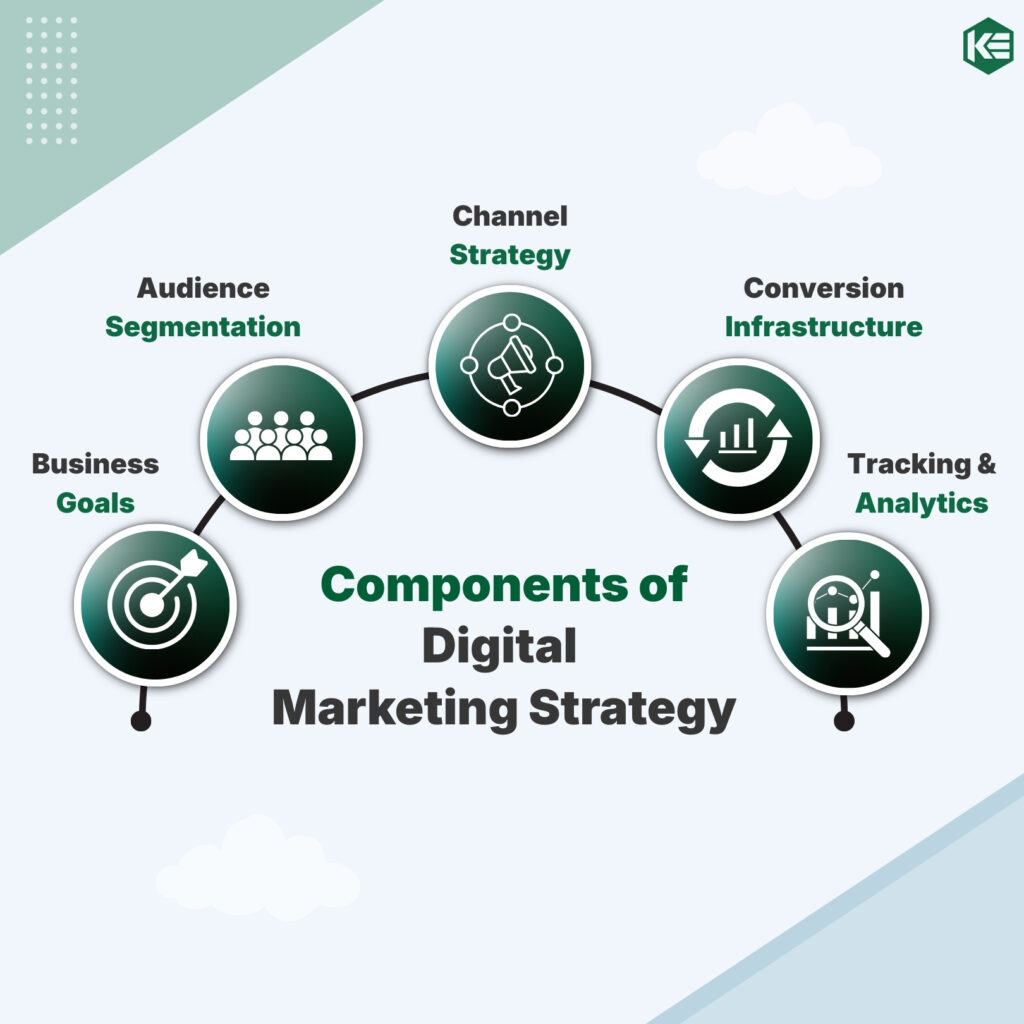
1. Clear Business Goals and Marketing KPIs
Every digital marketing strategy begins with clarity. Before selecting channels or launching campaigns, businesses must define:
- Revenue targets
- Lead generation goals
- Customer acquisition cost benchmarks
- Customer lifetime value expectations
Marketing goals should be aligned with business outcomes, not vanity metrics. For example, increasing website traffic without improving conversion rates does not drive sustainable growth.
In Malaysia’s competitive market, SMEs often benefit from setting short-term (90-day) performance targets while maintaining long-term growth objectives.
2. Audience Segmentation and Customer Analysis
A digital marketing strategy without audience clarity leads to wasted budget and inconsistent messaging.
Audience segmentation helps businesses identify:
- High-value customer profiles
- Behavioural patterns
- Purchase intent stages
- Content preferences
Understanding how Malaysian consumers search and engage online is critical. Some audiences rely heavily on social platforms like TikTok and Instagram, while others prefer Google search or direct referrals. By combining customer analysis with analytics tools such as GA4, businesses can refine targeting and improve marketing efficiency.
3. Channel Strategy: SEO, SEM, Social Media, and Email
One of the biggest mistakes in digital marketing is treating channels independently. A structured digital marketing strategy integrates multiple channels based on their strengths.
- SEO (Search Engine Optimization) supports long-term visibility and organic traffic growth.
- SEM (Search Engine Marketing) drives immediate traffic through paid ads.
- Social Media Marketing builds awareness, engagement, and brand positioning.
- Email Marketing nurtures leads and strengthens customer relationships.
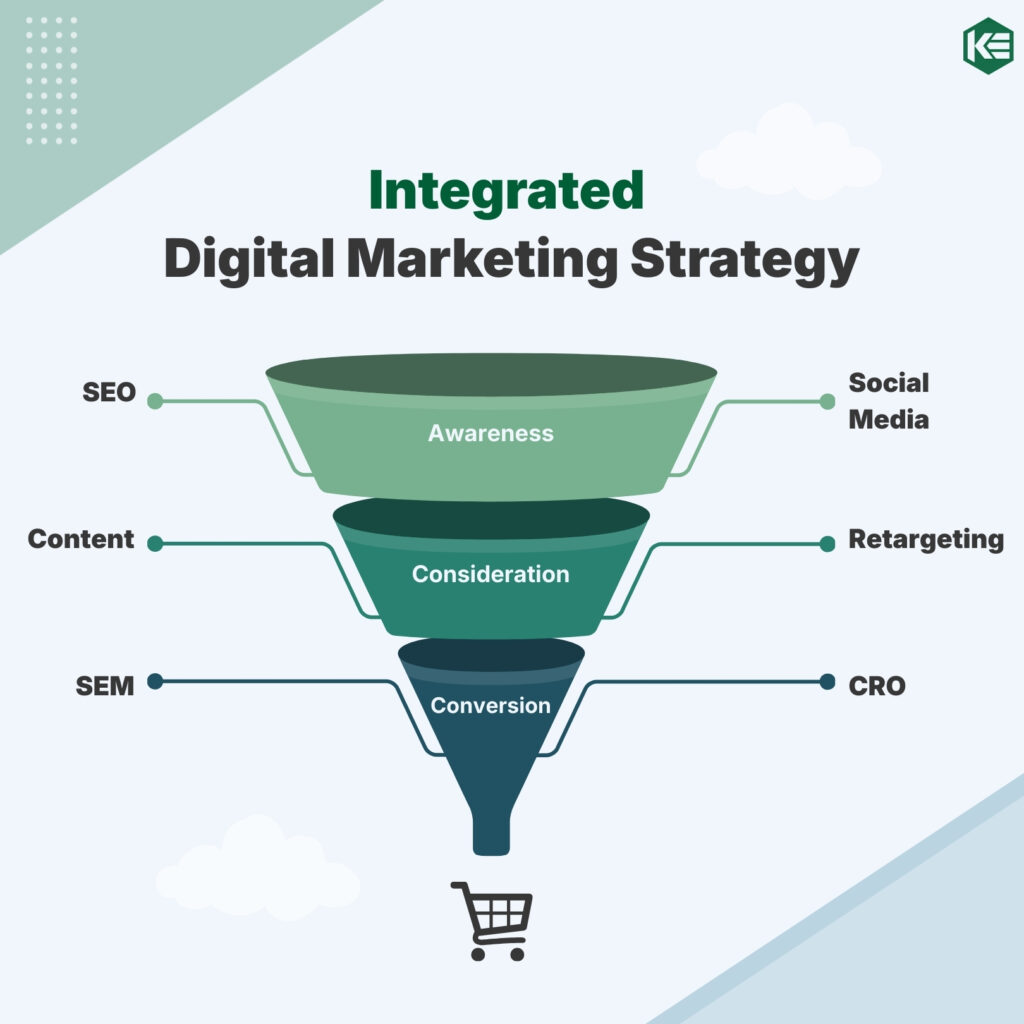
Rather than asking whether SEO or SEM is better, Malaysian businesses should evaluate how each channel supports different stages of the customer journey. An integrated channel strategy ensures that traffic acquisition, engagement, and conversion work together.
4. Conversion Infrastructure: Landing Pages and CRO
Traffic alone does not generate revenue. A digital marketing strategy must include conversion infrastructure.
Conversion infrastructure includes:
- Optimised landing pages
- Clear call-to-action structure
- Mobile responsiveness
- Fast loading speed
- Trust signals and social proof
Conversion Rate Optimization (CRO) improves how effectively traffic turns into leads or customers. In Malaysia’s mobile-driven market, page speed and UX significantly impact conversion performance. Without conversion infrastructure, even high-performing campaigns fail to produce strong returns.
5. Tracking, Analytics, and Performance Measurement
A digital marketing strategy must be measurable.
Many businesses install analytics tools but fail to configure meaningful tracking. Effective strategy requires:
- GA4 setup with event tracking
- Conversion tracking implementation
- UTM structure for campaign monitoring
- KPI dashboards for decision-making
Data-driven marketing allows businesses to optimise based on performance rather than assumptions. In Malaysia’s increasingly competitive landscape, companies that rely on structured analytics consistently outperform those relying on intuition.
How to Align SEO, Ads, and Social Media Into One Strategy
An integrated digital marketing strategy connects awareness, consideration, and conversion.
For example:
- SEO captures long-term search demand.
- SEM captures high-intent search queries.
- Social media builds brand familiarity and retargeting audiences.
- Retargeting ads re-engage visitors who did not convert initially.
When these elements operate together, marketing performance becomes predictable and scalable.
Instead of asking which channel works best, the better question is how each channel contributes to the overall digital marketing strategy.
Common Digital Marketing Strategy Mistakes
Even with a defined digital marketing strategy, businesses may face execution gaps.
Common mistakes include:
- Launching ads before defining audience segments
- Investing in SEO without clear conversion goals
- Ignoring customer data and analytics insights
- Focusing on short-term tactics rather than long-term positioning
Avoiding these pitfalls strengthens the impact of a structured digital marketing plan.
A Practical 90-Day Digital Growth Roadmap
To make this framework actionable, here is a simplified 90-day roadmap for Malaysian SMEs.
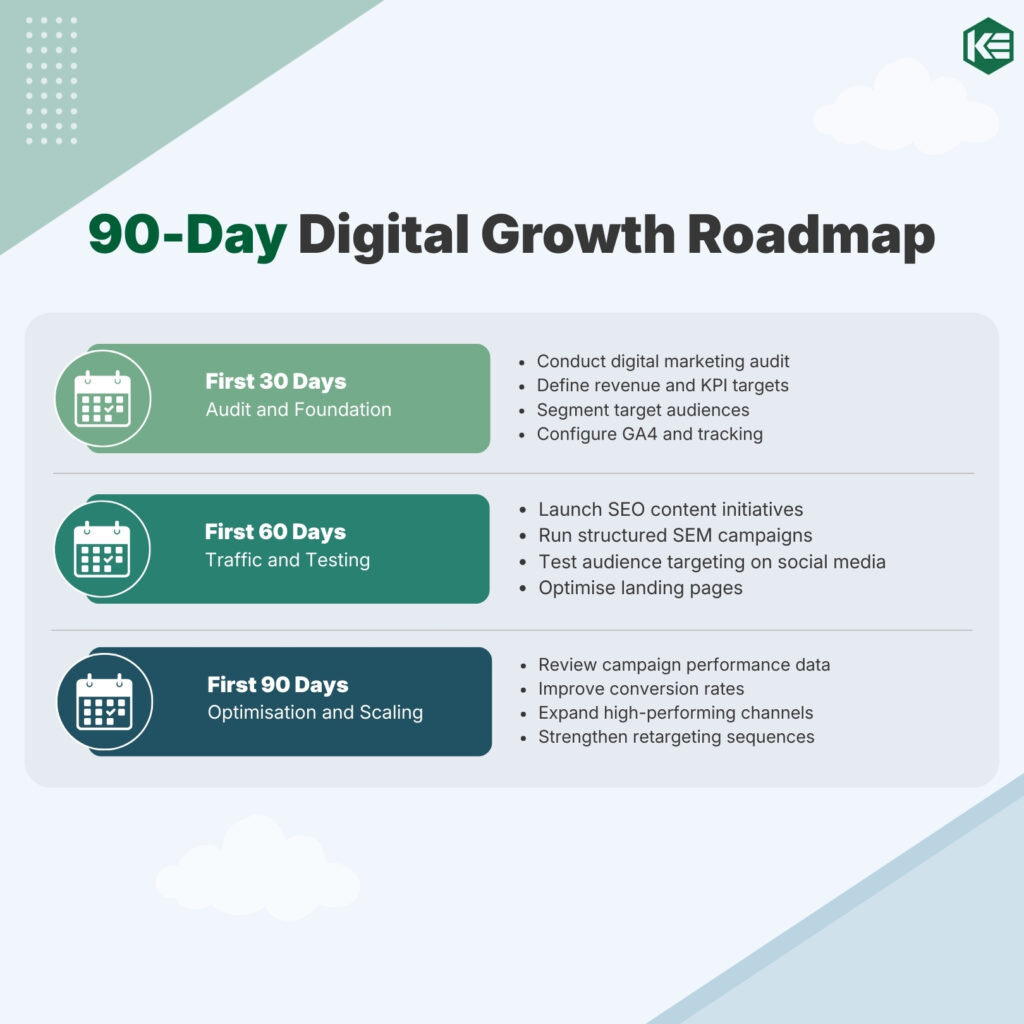
Month 1: Audit and Foundation
- Conduct digital marketing audit
- Define revenue and KPI targets
- Segment target audiences
- Configure GA4 and tracking
Month 2: Traffic and Testing
- Launch SEO content initiatives
- Run structured SEM campaigns
- Test audience targeting on social media
- Optimise landing pages
Month 3: Optimisation and Scaling
- Review campaign performance data
- Improve conversion rates
- Expand high-performing channels
- Strengthen retargeting sequences
This structured timeline turns strategy into execution.
When Should Businesses Seek Digital Marketing Advisory?
As digital marketing grows more complex, many teams end up “busy” but still can’t answer one simple question: which activities are actually driving revenue? Advisory support becomes valuable when you need strategy + measurement + execution alignment, not just more campaigns.
Businesses should consider professional advisory support when:
- Growth plateaus even though ads, social media, and content are active
- Your team is reporting numbers, but cannot tie results to pipeline or revenue
- Tracking is inconsistent (GA4/Tag Manager events, leads, calls, forms, WhatsApp, purchase actions)
- You have multiple channels running (SEO, SEM, social, email) but they don’t work as one system
- Leads are coming in, but lead quality is unpredictable and follow-up feels messy
- Management asks for ROI, but reporting is not decision-making friendly (no clear KPI dashboard)
Strategic advisory typically covers areas like digital due diligence, GA4 measurement + governance, customer/audience analysis, and CRO (conversion rate optimisation) to improve performance across the full journey from traffic to conversions.
Rather than treating each channel as a separate project, a structured advisory approach helps businesses build a repeatable growth system with clearer priorities, stronger measurement discipline, and better budget allocation.
For teams that already execute in-house, advisory is most useful when you need senior strategy and a stronger MarTech/measurement layer.
Final Thoughts: Strategy First, Channels Second
Digital tools and platforms continue to evolve. New advertising formats, AI-driven analytics, and automation tools emerge constantly. However, tools alone do not drive growth. A clear digital marketing strategy provides direction. It aligns goals, audiences, channels, conversion systems, and analytics into a unified growth engine.
For Malaysian businesses aiming to scale sustainably, the focus should not be on chasing trends. Instead, it should be on building a structured digital marketing strategy that integrates data, technology, and execution.
When strategy leads, channels perform better.
When data guides decisions, growth becomes predictable.
And when marketing aligns with business objectives, results become measurable.